Here is something that happens far more often than anyone admits. A coach builds an intake questionnaire over a few years twenty or so questions covering sleep, energy, motivation and mood. It is well written. It works. And several of those questions are, almost word for word, items from a validated depression screening instrument.
Not copied from anywhere. Written independently, the obvious way to ask someone about low mood is the way clinicians settled on decades ago, which is precisely why those items ended up in the instrument in the first place.
And they are usually scored. Often summed. Which means a total goes back to a client who has no way of knowing the number is not a clinical finding.
This is the most common mistake in behavioural health coaching, and it is nearly always made by good coaches acting in good faith. It is also getting easier to make, because AI will draft those items for you on request they are all over its training data and a drafted question set looks finished in a way a blank page does not.
Below are six question types that move an assessment from coaching into clinical screening, what to ask instead, and how to review an AI-drafted set before it reaches anyone.
One thing first: this is not legal or clinical advice. Scope of practice varies by country, state and credentialing body, and yours is the one that governs you. Check it.
What behavioural health coaching covers, and what it does not
The distinction that matters is not subject matter. It is function.
Coaching works on present-day behaviour, habits and goals with a client who is functioning and wants to function better. Clinical work assesses, diagnoses and treats conditions. Both can involve sleep, mood, stress and motivation the topics overlap almost completely, which is exactly why the boundary gets crossed by accident rather than intent.
You cross it when you start measuring against a clinical standard rather than coaching against a client's own goal. Same topic, different act.
Six question types that cross the line
1. Symptom-frequency items
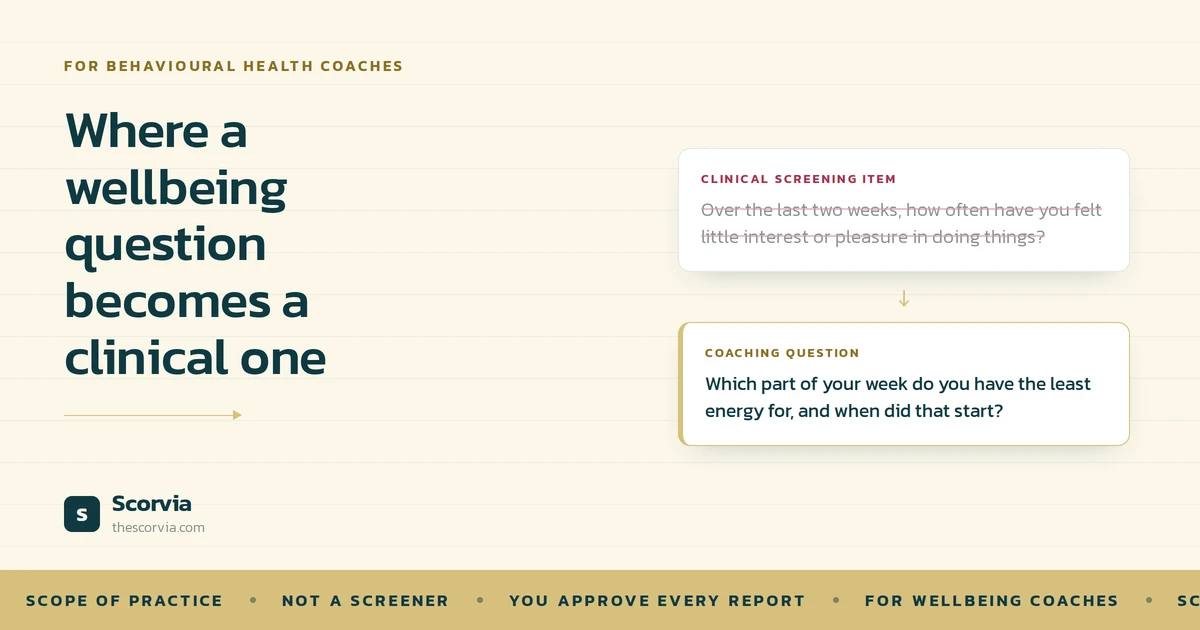
The most common accidental crossing, and the hardest to spot, because these questions sound perfectly reasonable. “Over the last two weeks, how often have you felt little interest or pleasure in doing things?” is not a wellbeing question that happens to resemble a screening item. It is a screening item, almost word for word, from an instrument designed to be scored by clinicians against published thresholds. Ask it in a coaching assessment and you have collected clinical data you are not qualified to interpret. Instead, ask about a specific domain and what changed: which part of the week they have least energy for, and when that started. You get something you can coach and nothing you cannot.
2. Anything about self-harm or suicide
There is no version of this that belongs in a coaching intake, including the softened ones. Not “have you ever felt life was not worth living”, not “on a scale of one to ten, how hopeless do you feel”. The problem is not the wording. It is that a written form cannot respond, and a coach reading the answer three days later has created a duty they had no way to discharge in the moment. Instead of a question, have a protocol: know your referral routes before you need them, and put the crisis contact for your country on the assessment itself where a client can see it without answering anything.
3. Diagnostic labels used as categories
“Do you experience anxiety?” looks like a simple screening question and is actually an invitation to self-diagnose, which you then build a plan on. The client may be describing ordinary pressure, an undiagnosed condition, or a diagnosis they already have and did not mention. You cannot tell which, and the label makes it harder rather than easier to find out. Instead, ask about the situation and the behaviour: what happens the night before a difficult meeting, what they do about it, and whether it is getting easier or harder. Situations are coachable. Categories are not yours to assign.
4. Summed severity scores
This is the one that turns a set of individually defensible questions into something else. Score five symptom items, add them up, and you have built a severity index which implies a threshold, and a threshold implies a judgement about whether someone is unwell. Even with no cut-off written down, a client who sees 17 out of 25 will read it as a verdict. Score habits, routines and behaviours instead: sleep timing, movement, recovery, boundary-setting. Those add up to something a client can act on rather than something they must interpret.
5. Medication and clinical history as plan inputs
Knowing a client is under a clinician's care is useful. Building your coaching plan around their diagnosis or medication is not, and the line between the two is thinner than it looks. A question like “what are you currently taking and at what dose” collects information you have no clinical basis to act on and now must store. Instead, ask one thing: whether they are working with a clinician, and whether they would like you to coordinate. That gives you the only fact that changes what you do who else is involved and nothing you must be careful with.
6. Open trauma probes
“Tell us about any difficult experiences in your past that might be affecting you now” is a question with no floor. It invites a disclosure the client may not have made to anyone into a text box, with no support in the room and no session booked for another week. Coaches who would never ask it aloud in a first meeting ask it in writing all the time, because a form feels less confronting to write than to say. Instead, keep the assessment on present-day functioning, and let history come up in a session where you can respond to it.
Why AI drafting makes this both easier and riskier
Worth being straight about, since this post is on a site that sells AI assessment software.
AI drafting genuinely helps. Describe the specialization you work in, and you get a question set in the right vocabulary in seconds, which is a real improvement on adapting last year's document for the ninth time. It is particularly good at the behavioural questions that a template usually leaves out.
It will also draft a screening instrument if your prompt sounds like one. Ask for questions to assess a client's mental wellness and some of what comes back will look like the PHQ-9, because that is what the phrase is attached to in almost everything the model has read. It is not malfunctioning. It gives you the most typical answer to the question you asked.
Which makes the review step the whole safeguard. An AI draft is the first draft you own read it with this list in hand and delete rather than soften.
In Scorvia this is how it is built rather than a habit you must remember. The AI drafts, you keep what fits and delete the rest, and you add your own questions anywhere in the set. Nothing is published to a client until you have read it. There is more to wording individual questions well in our piece on writing assessment questions clients answer honestly.
Decide the referral question before you need to
Every coach working in this territory will eventually read an answer that worries them. The difference between handling it well and badly is almost entirely about what you sorted out beforehand.
•Know your referral routes now which services, which numbers, what the wait looks like locally.
•Put the crisis line for your country on the assessment itself, visible without answering anything.
•Reach out directly rather than waiting for the next scheduled session.
•Write two or three lines on the assessment saying it is not a clinical assessment, does not diagnose, and is not a substitute for medical advice.
That last one takes a minute and does more than any amount of careful wording elsewhere, because it sets the client's expectation before they answer rather than after.
One more reason reports should not send themselves
Most assessment tools email the result to the client the moment they finish. For behavioural health work that is the wrong default, and not by a small margin.
A client reading an AI-written summary of their own difficulties, alone, with no practitioner present and no session booked, is a bad outcome even when every word of the summary is accurate. And if something in their answers needed a human response, the first person to see it should be you.
Scorvia drafts the report into your review queue rather than the client's inbox. You rework any section, add a coach note above the AI's work in your own words, preview the client-facing version, and approve it. Nothing reaches anyone under your name until you have read it which on this subject is not a convenience, it is the design.
Common questions
Is an AI assessment for behavioural health coaching allowed to ask about symptoms?
It depends entirely on what you do with the answers. Asking a client how they slept last week is fine. Asking a validated symptom-frequency item, scoring it and summing it into a severity total is clinical screening, whoever built the form. The test is not whether the question mentions how someone feels it is whether you are measuring against a clinical threshold or coaching a behaviour.
Does using AI to draft the questions make this more or less risky?
Both, and knowing which is the point. AI drafting makes it far easier to produce a good question set in the right vocabulary, and it will also cheerfully draft something that reads like a screening instrument if that is what your prompt implies, because those items are all over its training data. The safeguard is that you review and approve every question before it goes out. Read the draft with this list in hand and delete rather than soften.
What should you do when a client's answer worries you?
Have decided in advance. Know which local services you refer to, have the details to hand, and reach out directly rather than waiting for the next scheduled session. This is also the strongest argument for reports landing in your review queue rather than going to the client automatically the first person to read a concerning answer should be you, not a client reading an AI summary of their own distress with nobody there.
Should the assessment itself carry a disclaimer?
Yes, on the assessment and not only in your terms. One or two lines saying this is not a clinical assessment, does not diagnose, and is not a substitute for medical advice, plus the crisis number for your country. It costs nothing, it sets the client's expectation before they answer, and it is the difference between a boundary you hold and a boundary you assume.
Is Scorvia a clinical or diagnostic tool?
No. Scorvia does not diagnose, does not screen for clinical conditions and is not a medical device. It drafts the questions you have decided to ask and writes the first draft of the report, and you approve everything before a client sees it. If your work needs a validated instrument, license the instrument Scorvia is for the coaching diagnostic you wrote yourself.
Scorvia drafts your questions and your reports, and you approve everything before a client sees it. It does not diagnose and is not a clinical instrument. See how it works for behavioural health coaches, or start a 14-day free trial with no card required.