The email that changes a coaching practice usually reads something like this: “We liked the session. Could you run the same thing across the leadership team? There are seventeen of them.”
It is the best email you will get all year and the one most likely to go badly. The process you use for one client, a document you adapt, a form you send, an evening spent writing the report does not survive being multiplied by seventeen. Seventeen evenings is not a project. It is a month of your life for a fee that assumed a week.
So, most coaches do one of two things. They turn the work down, or they take it and quietly hand back something thinner than what they sell to individuals: one team-level summary, a few charts, an average. The client accepts it, does nothing with it, and does not come back the following year.
There is a third option, and it is mostly a matter of deciding a few things up front and letting the software carry out the repetition.
Why one team report is the wrong deliverable
Start here, because it determines everything else. A merged team report feels efficient and is almost always the reason cohort work fails to renew.
The problem is that averages hide the thing you were hired to find. If four managers in a team of seventeen are struggling badly with difficult conversations and the other thirteen are fine, the team average reads “slightly below expectation” and nobody does anything. Nobody recognizes themselves in a mean. The four people who needed help do not know they were the four.
Individual reports work because each person reads a description of their own situation, in their own numbers, and can act on it that week. The team picture is something you build afterwards from those individual results as your analysis, in your words, which is the part the sponsor is actually paying you for.
Decide these four things before you build anything
Cohort work goes wrong at the design stage, not the delivery stage. Four decisions, and they take about twenty minutes.
| Decision | What goes wrong if you skip it |
|---|---|
| Who reads what | Sponsors assume they will see every individual report. Participants assume nobody will. Settle it in writing before the first invitation goes out, and tell the participants what you agreed it changes how honestly, they answer. |
| Individual or role-based questions | A question that makes sense for a team lead is often meaningless for a director. Either write for the level you have, or branch so that each person answers what applies to them. |
| What you will compare | If you want to reassess in six months, the questions have to stay identical. Decide the baseline set now, because you cannot compare against questions you later rewrote. |
| Where the line sits on anonymity | Named assessments produce reports people can act on. Anonymous ones produce engagement data. You cannot do both in one instrument, and trying to is the most common design mistake in teamwork. |
Build one assessment, not twenty
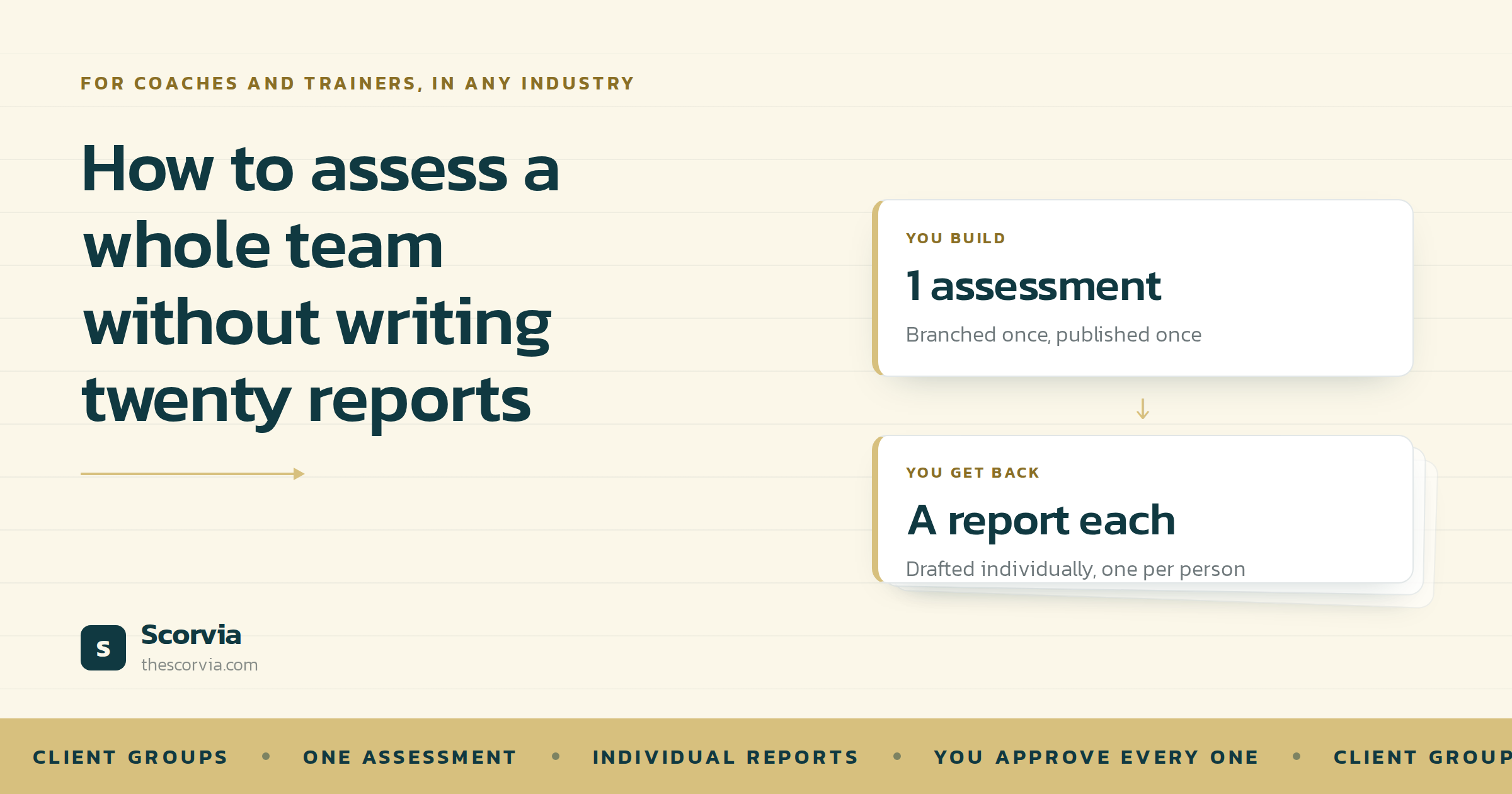
The mechanics matter less than people expect, provided the tool assigns one assessment to a named group rather than making you duplicate it per person.
In Scorvia this is Client Groups. You build the assessment once, publish it once, and assign it to a named set of people a cohort of trainees, a leadership intake, a whole department. Each person answers under their own login, and the reports come back individually drafted, one per person. Nobody sees anyone else's answers, and you are not maintaining seventeen near-identical copies of the same questionnaire.
Two things are worth doing properly while you build it.
•Use branching instead of length. A multiple-choice or true/false answer can send a client down a different path, which means one assessment can serve a mixed-seniority cohort without asking a team lead about board reporting. A twelve-question assessment that adapts beats a forty-question one that does not, and cohort completion rates are where that difference shows up hardest.
•Score only what deserves a number. Multiple-choice and true/false options can carry marks, and multi-select questions sum them, which gives you the charts a sponsor expects. Open text stays unscored, because a paragraph is not a number and in team work the open-text answers are usually where the actual finding is.
If you have run similar work before, your own question library is offered back to you for the specialization you are building, so a question you wrote for last year's cohort can be dragged straight in rather than written twice.
The report problem, and the only thing that solves it
Here is the arithmetic that stops most people. Seventeen reports, written by hand at roughly an hour each, is seventeen hours before any of the coaching happens. That is the whole margin on most cohort contracts.
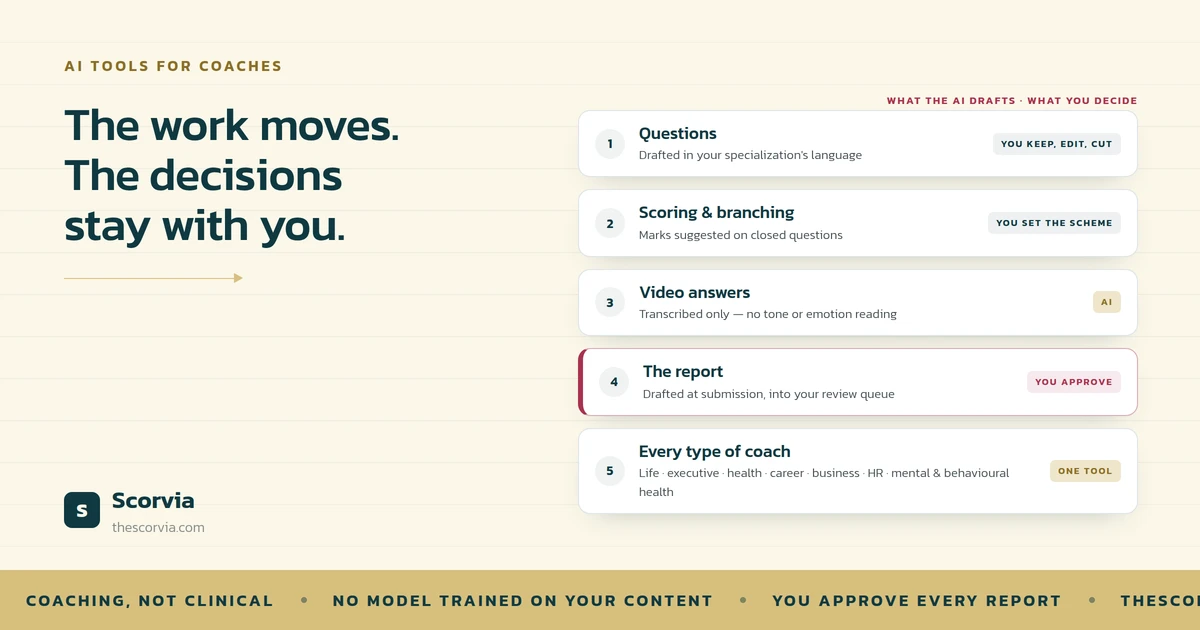
What changes is not a template. Templates still need filling in, and a filled-in template reads like a filled-in template. What changes it is the report being drafted from the answers before you open it: executive summary, key findings, strength areas, improvement areas, recommendations, with the scores and charts alongside.
The drafts land in your review queue, not in anyone's inbox. Then you do the part that is yours:
•Rework one section, not the whole report. Ask for a softer tone in the summary for a nervous first-timer, or more detail in the recommendations for a corporate sponsor. Every other section and your coach stay exactly as they were.
•Add a coach note. It sits at the top of what the client reads, above the AI's work, in your words. Across a cohort this is where you do the differentiating three sentences that only apply to that person.
•Check the client version. Toggle to the report written in the second person, so it reads as addressed to them rather than about them. Worth doing on the first two or three; after that you will know what it does.
•Roll back if a rewrite came out worse. Every version is kept, which matters more when you are moving quickly through seventeen of them than it does on one.
Reports carry your logo and profile details and download as PDF, so what the sponsor's team receives looks like it came from your practice rather than from a piece of software.
What to do with seventeen reports once you have them
This is the part no tool does for you, and it is where the renewal comes from.
Read all of them in one sitting, before you send any. Patterns show up fast the same improvement area appearing in eleven of seventeen, or a strength the organisation clearly does not know it has. Write those down as you go.
Then write the sponsor summary yourself, from the patterns, not from an average. Three or four findings, each one supported by how widely it appeared, each one with something the organisation can do about it. Name no individuals unless you agreed that in writing at the start. That document is what gets forwarded to a board, and it is the reason you get asked back not the seventeen reports, which belong to the seventeen people.
Finally, agree with the reassessment date before you leave. Same questions, six months later, is the only way to show movement, and it turns a one-off project into a programmed.
If you have associates working with you
A company account lets you invite assistant coaches and hand each one of the clients they are looking for. They work in the same workspace, on their own availability, and see only the clients you gave them. Selling and pricing stay with your packages belongs to the account owner.
For a cohort of any size this is usually how the work gets delivered: you design the assessment and write the sponsor summary, your associates take the individual debriefs. The reports are consistent because they came out of one instrument, and the follow-up sessions are booked directly from the report page into real availability rather than through a chain of emails.
Three things this approach will not do
Worth saying plainly, because two of them come up in almost every corporate conversation.
•It is not 360-degree feedback. Assessments go from you to a client. There is no way to collect ratings about one person from their manager, peers and reports and aggregate them. If the sponsor asked for 360 specifically, you need a dedicated multi-rater tool and it is much better to say so in the first meeting than in the third.
•It is not an anonymous engagement survey. Every assessment is answered by an invited client under their own login. There are no public links and no anonymous submissions. That is right for named development work and wrong for measuring how a department feels about management, which is a different exercise with a different tool.
•There are no validated norms. Questions can be scored and reports show scores and charts, but there are no percentile bands against a wider population. If the contract calls for a licensed psychometric instrument, license it and run your own diagnostic alongside it rather than instead of it.
The short version
Individual reports for participants, one written summary for the sponsor. Never a merged average.
Settle who sees what, in writing, before the first invitation goes out.
Build one assessment and branch it, rather than building one per role.
Keep the question set fixed if you intend to reassess later.
Let the reports be drafted, then spend your time on the coach notes and the sponsor summary.
Book the reassessment before you leave the room.
Scorvia builds the assessment, drafts every report, and gives each person their own login and nothing sends until you approve it. There is a 14-day free trial of the whole workspace, AI included, with no card required. Build one assessment and see what comes back.