Open banking gave advisors something genuinely useful: a complete, accurate picture of where a client's money goes. Categorised, reconciled, no missed subscriptions, no guessing.
And it turned out that was the easy half.
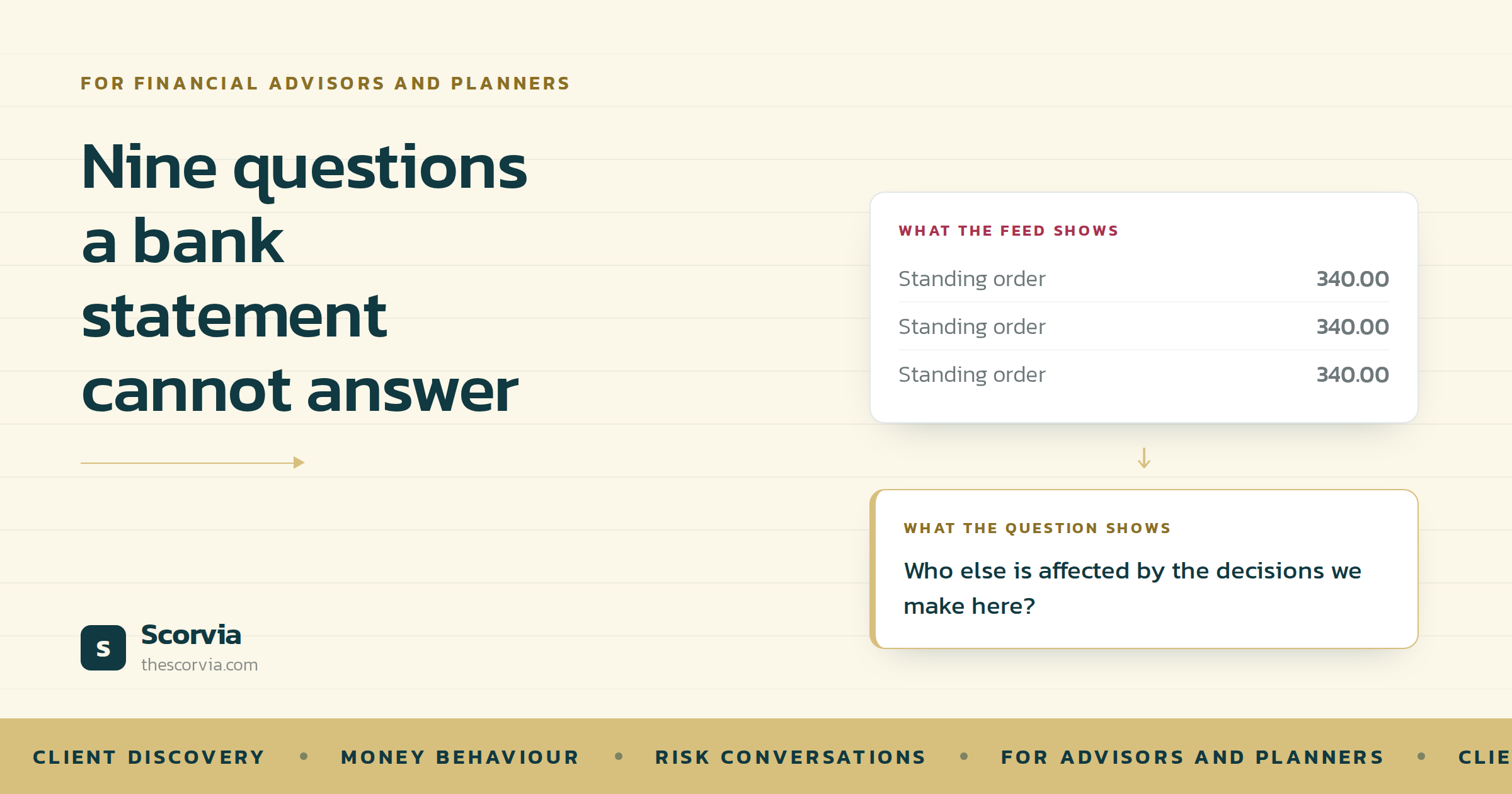
A transaction feed tells you that £340 left the account on the 3rd. It does not tell you that it goes to a brother who has been struggling since a divorce, that it is never mentioned to the client's spouse, and that it is the single reason the pension contribution has not moved in three years. Two clients with identical statements can need opposite plans, and nothing in the data distinguishes them.
The gap between what a client's money does and why it does it is where the advice actually lives. You only get at it by asking.
Below are nine questions that get at it. They are not a script and they are not a compliance instrument your suitability and KYC process is defined by your regulator and none of this touches it. They are the discovery questions worth the time, with what each one is actually for.
The nine questions
1. “Think about a month that went badly. What happened?”
Averages hide everything that matters. A client whose outgoings look fine across twelve months may have three months a year that undo the other nine, and those three months are the plan. Asking about the bad month rather than the typical one gets you the car repair, the wedding, the quarter where the freelance work dries up the pattern that a mean smooths flat.
2. “What did you actually do the last time markets fell sharply?”
This is the single most useful question in risk profiling, and it is not the one most risk questionnaires ask. Stated risk tolerance and demonstrated risk behaviour are different things, and only one of them shows up in a portfolio. Someone who describes themselves as a seven out of ten and sold everything in March 2020 is not a seven out of ten. Ask what they did, not what they would do.
3. “Is there money sitting in cash you have been meaning to move? How long has it been there?”
The second half of that question is the whole question. Everybody has an intention; the interesting number is how long the intention has been outlining the action. Four years of inertia tells you something a balance sheet cannot: that the barrier is not information and giving them more information will not move it.
4. “If your income stopped tomorrow, how many months before something has to change?”
Watch whether they know. An answer given instantly is a client who has already thought about resilience. A long pause is a finding, and it is a better opening for a protection conversation than any product comparison because they arrived at the gap themselves rather than being sold it.
5. “What have you spent money on in the last year that you would spend again without hesitating?”
Discovery skews towards what people regret, which makes it feel like an audit and puts clients on the defensive. This question does the opposite and is more useful for it: it tells you what the money is for. Plans built around what someone values survive contact with reality; plans built around what they should cut do not.
6. “Who else is affected by the decisions we make here?”
Partners, parents, adult children, a business co-owner, someone quietly supported every month. Advisors find out about the fifth of these in year two, usually when it derails something. Asking in week one is free, and the answer often reshapes the whole engagement.
7. “What did money look like in the house you grew up in?”
The most revealing question on this list and the one to place carefully late in the set, optional, open text. Attitudes to spending, debt and risk are largely inherited, and a client who watched a business fail in childhood behaves differently from one who watched a mortgage get paid off early. You are not doing therapy. You are finding out why the obvious advice has not worked before.
8. “What is the thing you are slightly worried I will judge you for?”
It sounds bold written down. In practice it is the question clients ask you for, because they were already carrying the answer and looking for permission to say it. The undisclosed credit card, the loan to a sibling, the pension they cashed in. Better in week one than in year three, and better in writing than out loud — which is exactly what a written assessment gives you.
9. “Twelve months from now, what has to be true for you to say this was worth it?”
This is the question that turns discovery into a measurable engagement. It gives you the client's own definition of success in their own words, which is what the recommendations should be written against — and what you reassess in twelve months to show whether it happened.
Three rules that matter more than the questions themselves
A good question asked badly gets a defensive answer, and a defensive answer is worse than no answer because it looks like data.
•Ask about specific occasions, not general tendencies. “How disciplined are you with spending?” gets you a self-image. “Think about last December what happened?” gets you an event. People are unreliable narrators about their habits and reasonably reliable about their weeks.
•Never let a question imply the right answer. “How much has poor budgeting held you back?” has told the client what you think before they answer. The moment a question carries a judgement, you stop collecting information and start collecting agreement.
•Put the exposing questions last. Questions seven and eight need trust that the first six build. Order is not decoration it is most of whether an honest answer arrives at all.
There is a longer piece on wording these properly in our post on writing assessment questions clients answer honestly, which goes through the six mistakes with before-and-after examples.
Ask them in writing before you ask them out loud
This is the part most advisors get backwards, and it costs them the best answers.
People are more honest about money in writing than in a room. Nobody is watching them work out the number, nobody is waiting while they decide how to phrase it, and they can stop and come back when a question needs thinking about. Question eight in particular the thing they are worried you will judge them for is answered far more often on a form at 10pm than across a desk at 10am.
It also changes what the first meeting is. Instead of an hour of data collection followed by a promise to send something over, you arrive having read their answers. The hour goes on the conversation. Clients notice, because it is the opposite of every financial meeting they have ever had.
The part that still takes an evening
Here is the honest problem with everything above. Nine good questions produce nine good answers, and nine good answers still must become a document the client can read and act on.
That is where the time goes. Not asking the writing up. An hour reading, an hour drafting so it sounds like you rather than like notes, twenty minutes formatting it into something you are willing to put your name on. Multiply by every new client, forever, and the ceiling on the practice is not your calendar, it is your evenings.
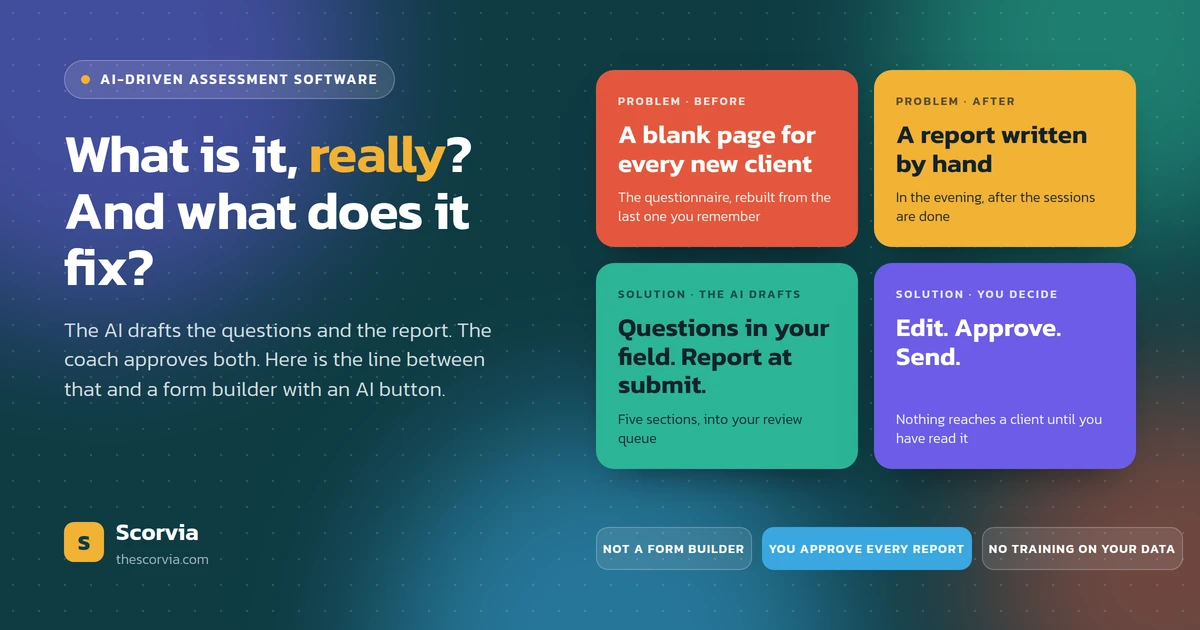
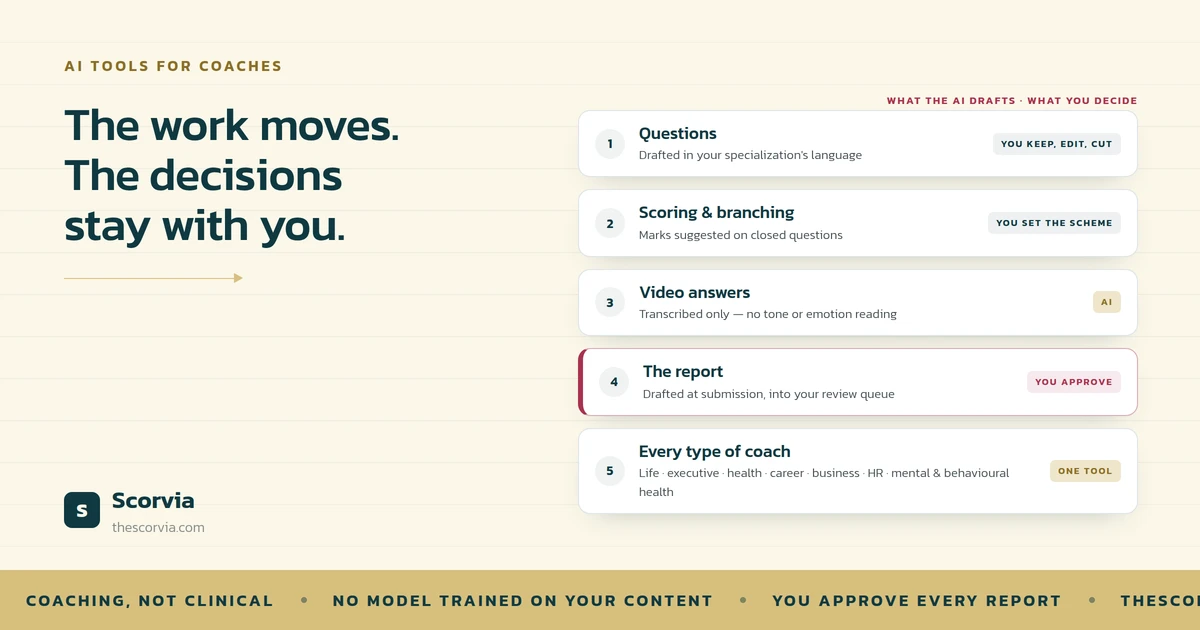
Scorvia was built for exactly that gap. You pick your specialization investment advisory, wealth management, tax planning, financial analysis, risk management and the AI drafts the question set in that vocabulary, including the behavioural questions a document template usually leaves out. Your client answers through their own login, one question at a time, saving and coming back. And when they submit, the report is already written: executive summary, key findings, strength areas, improvement areas, recommendations, with the scores and charts alongside.
It lands in your review queue, not in your client's inbox. You rework any section, add your advisor note above the AI's work in your own words, and approve it. Nothing goes out under your name until you have read it. Reports carry your logo and download as PDF.
Same nine questions. Same judgement. Without the evening.
Three months later you send the same set again identical wording, so the answers are directly comparable — and you can show a client that the thing they were worst at in January has moved. That comparison is the part a bank feed cannot produce, and a Word template never survives long enough to.
Where to start
•Pick four or five of the nine that fits how you work. Do not deploy all nine at once.
•Send them in writing before the first meeting, not during it.
•Put the exposing ones last and make the childhood question optional.
•Keep your compliance questionnaire exactly as it is this sits alongside it.
•Fix the wording once, then stop editing it, so you can compare answers over time.
Common questions
How many discovery questions should a financial advisor ask?
Fewer than most advisors think, and better ones. Twenty well-chosen questions that branch beat forty that everybody answers, because completion quality falls off a cliff after about fifteen minutes. Ask what changes the plan and cut the rest anything you can look up, calculate or ask later should not be occupying attention now.
Should discovery questions be asked in a meeting or in writing?
In writing first, then discussed in the meeting. People give more honest answers about overspending and debt when nobody is sitting across the table watching them answer, and they give better answers when they can pause and come back. It also means the first meeting starts with a shared document rather than from a blank page.
Are behavioural money questions appropriate for a regulated advice process?
They sit alongside it, not inside it. Your suitability and KYC questionnaires are defined by your regulator and should not be modified to accommodate anything here. These are discovery questions for the advice conversation, and they are not a substitute for a compliant risk assessment or a validated instrument.
How do you track whether the answers change over time?
Ask the same questions again on a fixed cadence and resist the urge to improve the wording between rounds. Comparability is the whole point, and a rewritten question breaks it. Pick a short check-in set, keep it identical, and run it quarterly.
Scorvia drafts the questions for your specialization and writes the first draft of every report you approve them before anyone sees them. See how it works for advisors or start a 14-day free trial with no card required.