Every leadership coach has run the debrief that went nowhere. The 360 comes back, the numbers are clear, you walk the client through them carefully, and they nod in all the right places. Six weeks later nothing changed.
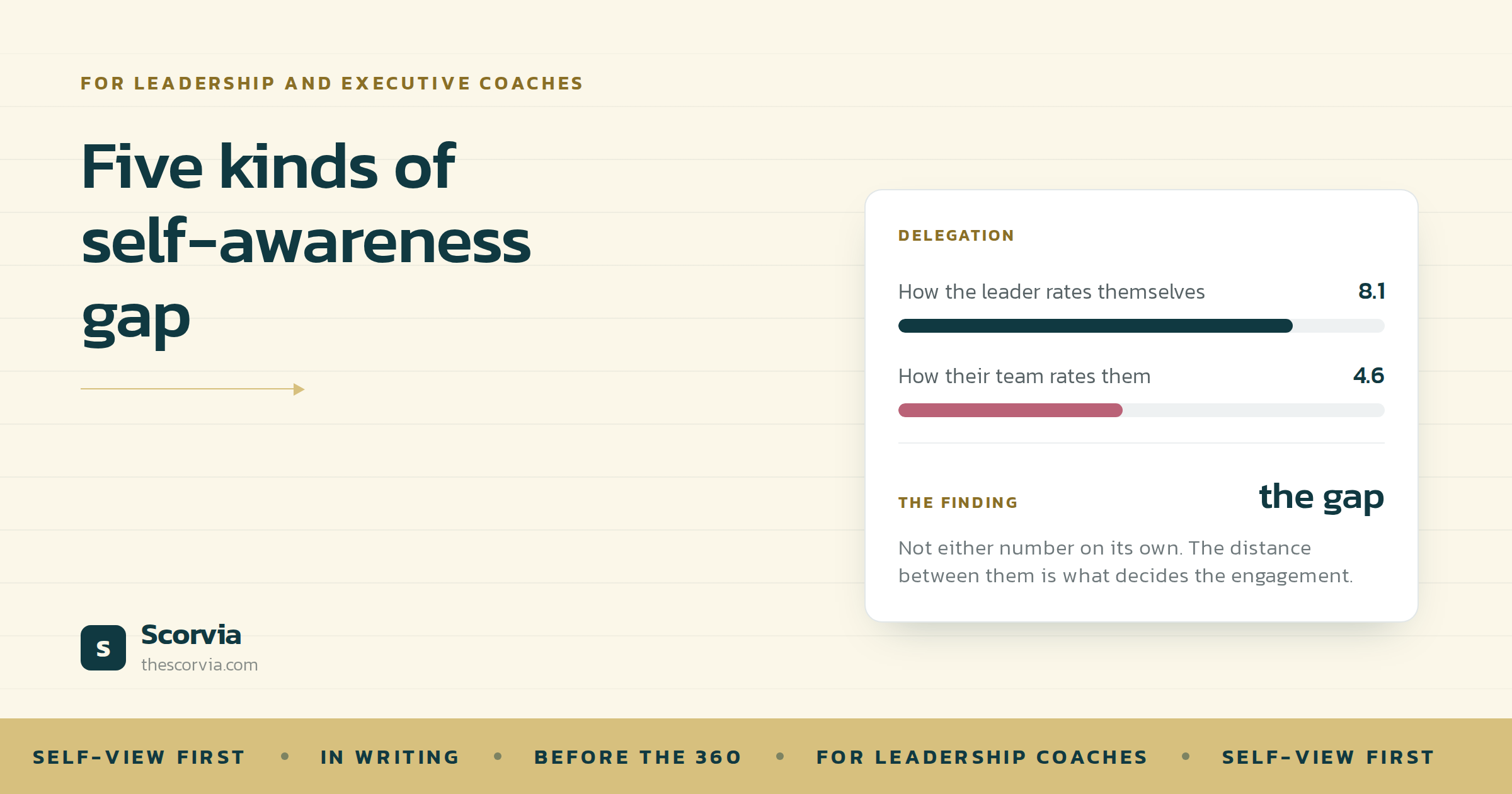
Usually, the problem is not the feedback and not the client. It is that the debrief treated one number as the finding, when the finding was the distance between two.
A 360 tells you how a leader is seen. It cannot tell you how they saw themselves before they were told. And the gap between those two is what determines the entire engagement.
Two directors can come back with identical scores on delegation and need opposite coaching, because one of them already knew and one of them is genuinely shocked. Same data, different work. Below are five patterns that gap takes, what each one means, and what to do with it.
Why the gap is the finding, not the noise
Self-ratings get treated as a formality a box the client fills in before the real data arrives. That is backwards. The self-rating is the only direct evidence you have of how the leader currently understands their own behaviour, and everything you do next depends on it.
It also has a short shelf life. Once feedback has landed, the self-view is contaminated by it. Ask afterwards what they thought before, and you get a reconstruction. The window for a clean baseline closes the moment the debrief starts.
The 5 patterns
1. The over-rater: they score themselves high, their team scores them low
The pattern everyone means when they say self-awareness gap, and the one most likely to be handled badly. The instinct is to present the evidence and let the numbers do the work, which almost always produces defensiveness followed by compliance and no change. What moves an over-rater is not more data but a specific incident they already remember. Ask what happened the last time a piece of work came back needing redoing and let them narrate it before any rating is discussed. The gap closes from the inside or it does not close.
2. The under-rater: they score themselves low, their team scores them high
Common in technically strong leaders promoted quickly and frequently misread as a confidence problem to be talked out of. It usually is not. Under-raters are typically holding themselves to a standard borrowed from somewhere specific a former manager, a parent, an early failure and reassurance bounce off a standard. The useful question is where the bar came from and whether they still agree with it. Coaching confidence without touching the standard produces a leader who feels better for two weeks.
3. Aligned and low: everyone agrees it is weak
The most misdiagnosed pattern, because it appears in a self-awareness conversation while having nothing to do with self-awareness. If a leader knows delegation is their weakness and their team agrees, awareness is not the problem capability, capacity or the system around them is. Something is preventing the behaviour rather than obscuring it. Look for the structural reason: no bench to delegate to, a boss who escalates everything, a role never designed to be doable. Coaching insight where the obstacle is workload wastes the engagement.
4. Aligned and high: everyone agrees it is a strength
Worth attention precisely because nobody flags it. The behaviour a leader is best at is the one they reach for under pressure, and an overused strength stops reading as a strength somewhere around the fourth application. Decisiveness becomes not listening. High standards become nothing is ever finished. Ask where the strength has recently cost them something most leaders can answer immediately and have never been asked.
5. The split reader: some raters high, some low
Often the most actionable pattern and the easiest to average away. A leader who rates well upward and poorly downward, or well with peers and poorly with their own team, is not inconsistent to them. they are behaving differently by audience, usually for a reason that made sense at some point. This is where a merged score a They destroys the finding, and it is a strong argument for reading makes individual response rather than the summary. What the leader thinks explains the difference is more useful than the difference itself.
Collect the self-view in writing, and collect it first
Two rules, and most coaches follow both consistently.
•In writing. A self-view gathered in conversation is a performance. The client is reading your face, calibrating, and adjusting as they go reasonably, because that is what people do in rooms. In writing, alone, with time to think, you get something closer to what they believe. It also gives you a record to compare against later, which a conversation does not.
•First. Before the 360 goes out, not alongside it and certainly not after. This is the part that is easy to get wrong for scheduling reasons and expensive to get wrong for coaching reasons.
What you ask matters as much as when. Ratings out of ten produce self-images; specific occasions produce evidence. “How well do you delegate?” tells you almost nothing. “Think about the last thing you took back off someone. What happened?” tells you which pattern you are in before a single rater has responded. There is more on wording this properly in our piece on writing assessment questions clients answer honestly.
The part that takes place in the evening
None of these is hard to design. A good self-assessment for a leadership engagement is fifteen well-chosen questions, and any experienced coach could write them in an afternoon.
The cost is everything after. Sending it, chasing it, reading it properly, and turning it into a document that stands next to a professionally produced 360 reports without looking like notes. Then doing it again at the midpoint, and again at the end, for every client, forever.
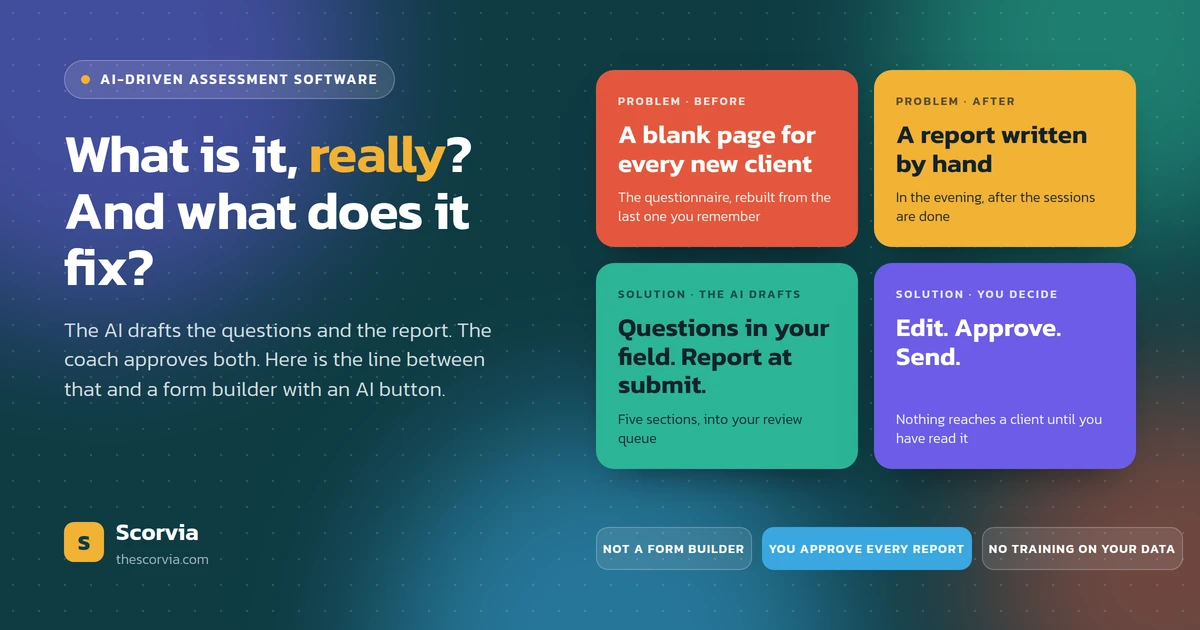
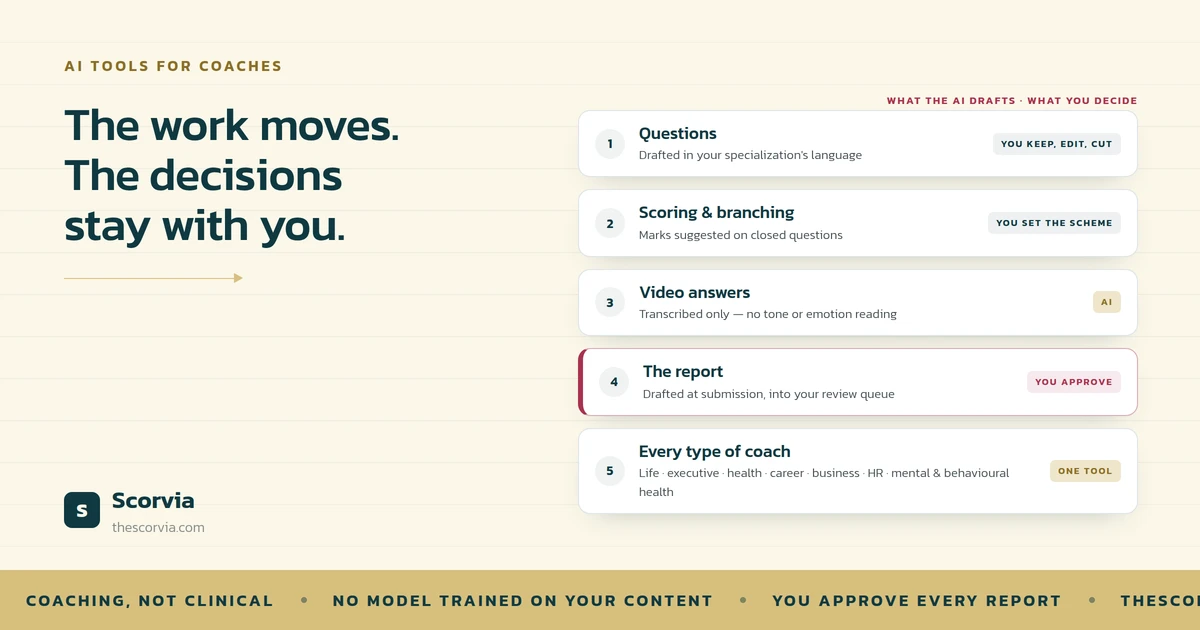
That is what Scorvia is for. You define the leadership areas you work in executive presence, delegation, first ninety days, whatever your practice actually is and the AI drafts a question set in that language. Your client answers through their own login, one question at a time, saving and coming back, which senior people reliably need. When they submit, the report is already written executive summary, key findings, strength areas, improvement areas, recommendations.
It lands in your review queue, not in your client's inbox. You rework any section, add a coach note above the AI's work in your own words, and approve it. Reports carry your logo and download as PDF, which matters when the document is going to sit alongside a 360 and go to a sponsor.
To be clear about what it does not do: Scorvia does not run the 360. There is no multi-rater collection and no aggregation. Keep your instrument for that half. This is the other half the self-view, the tracking and the writing.
Showing the gap close
Reassign the same assessment at the midpoint and again at the end. Identical questions, so the answers are comparable, which is the only honest way to show a sponsor that a leader's understanding of their own behaviour has actually moved, rather than asserting it.
Keep the check-in set short and resist improving the wording between rounds. A rewritten question breaks the comparison you spent six months building, and it is the most common way this goes wrong.
If you are running a cohort rather than one leader, Client Groups assign one assessment to a named set of people and return an individually drafted report for each of them which matters here more than usual, because pattern five is invisible in an average.
Common questions
Should the self-assessment come before or after 360?
Before, and in writing. Once feedback has landed, the self-view is contaminated by it you can no longer tell what the leader thought before they were told. Collecting self-view first gives you a clean baseline and turns the debrief into a comparison rather than a delivery.
Is a large self-awareness gap a bad sign?
Not on its own. Gaps are normal, and their direction and shape matter far more than their size. An over-rater and an under-rater can produce identically large gaps and need opposite engagements. What is genuinely concerning is a large gap the leader still disputes after seeing specific examples, because that is where coaching has the least to work with.
Can Scorvia run the 360 side of this?
No. Scorvia assessments go from you to one client, answered by that client about themselves there is no multi-rater collection or aggregation. Keep your 360 instruments for the 360. Scorvia handles the self-report half, the between-session tracking and the report writing, which is the half that currently costs you evenings.
How do you show a sponsor that the gap has narrowed?
Reassess with the same questions at the midpoint and the end of the engagement. Identical wording is what makes the answers comparable, and a movement in self-view alongside the next round of feedback is far more persuasive than a testimonial. Fix the check-in set early and resist rewriting it an improved question breaks the comparison you were building.
Scorvia drafts the questions for the leadership areas you define and writes the first draft of every report you approve them before anyone sees them. See how it works for leadership coaches or start a 14-day free trial with no card required.