AI-driven assessments help behavioural health coaches by drafting the intake and progress questions in the language of the coach's specialization sleep, stress, habits, routines and by drafting the client report from the answers the moment they are submitted. The coach edits the questions, edits the report and approves it before the client sees anything. The assessment asks about behaviour; it does not diagnose, screen or assess risk.
Behavioural health coaching runs on questions. What are you trying to change, what have you tried, what does a normal week look like, what gets in the way.
Put simply, an AI-driven assessment asks those questions in your field's language, and drafts the report from the answers, so you start from something to edit rather than nothing to write.
Here is what that means, why the field matters more here than almost anywhere, how to tell whether an assessment is fit for this kind of coaching, and where the line is that it must not cross.
What is an AI-driven assessment for a behavioural health coach?
A set of questions drafted for a specialization, answered by the client in writing or on video, that becomes a drafted report for the coach to edit and approve.
The word that matters is specialization. A generic wellness questionnaire asks everyone about everything. An AI-driven one is told what you coach sleep, stress, habit change, routines and writes its questions in the words those clients use.
It is a coaching tool. It asks about behaviour, and its report reflects what the client said. It is not a clinical instrument, and the rest of this post keeps coming back to that.
Why the field matters more here than anywhere
A generic questionnaire is a map of the wrong city. Accurate, detailed, and no use for finding your way.
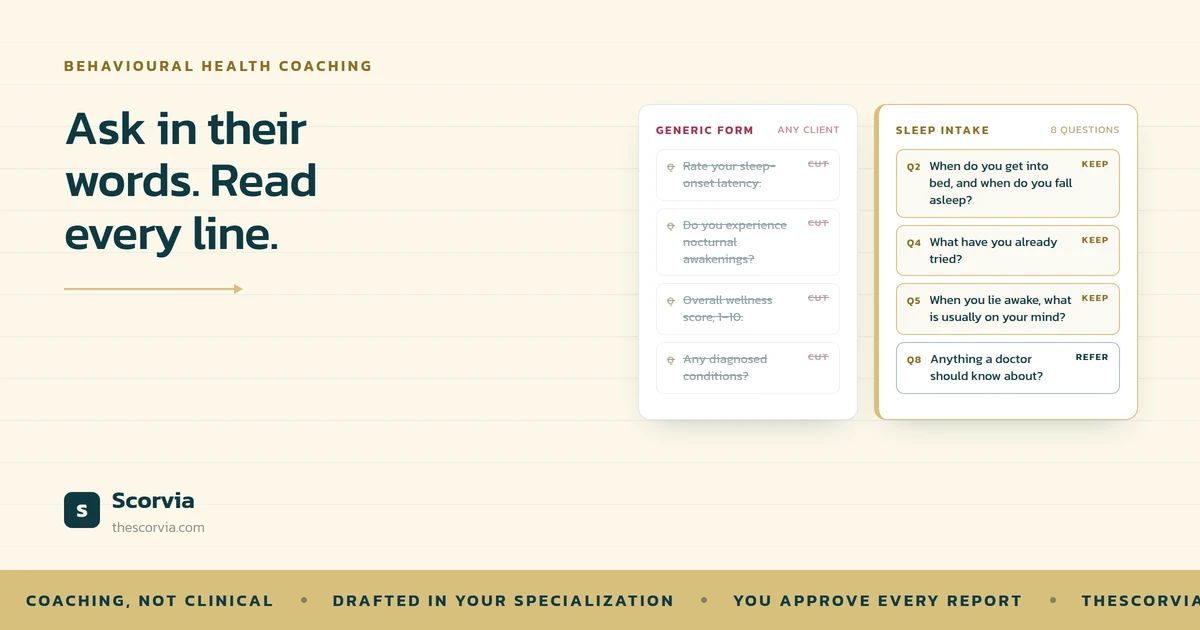
In behavioural health that is worse than elsewhere, because the wrong questions do not just waste time. They set the wrong tone. Ask a client about “sleep-onset latency” and they hear a clinic. Ask “what happens between getting into bed and falling asleep?” and they answer.
The language of the question decides the honesty of the answer. A client who feels assessed gives you the safe version. A client who feels asked gives you the real one.
So an assessment drafted in your specialization's language is not a convenience. It is the difference between an intake you can coach from and one you cannot.
Right field, right words, honest answers. The rest of the assessment is built on that.
How to tell whether an assessment is fit for behavioural health coaching
Three tests. Run any assessment AI-drafted or not through them.
1. Every question leads to something you would coach on
If an answer would not change what you do in session two, the question is filler. Behavioural health intake earns its length by being usable, not by being thorough.
2. It is in the client's language, not clinical language
A client says “I lie awake going over the day”, not “sleep-onset insomnia”. Questions written the first way get answered; questions written the second way get guessed at.
3. It does not pretend to measure what it cannot
A coaching assessment can score habits, routines and self-reported confidence. It cannot diagnose, screen or assess risk, and a good one never dresses its numbers up as if it could.
An assessment that passes all three is a coaching assessment. One that fails the third is something else wearing a coaching label, and it is the one to walk away from.
Where it lives in Scorvia
In Scorvia, you set your industry and the specializations you work in, and the AI drafts each question set for its specialization. If yours is not on the list, you request it from your profile and an admin reviews it.
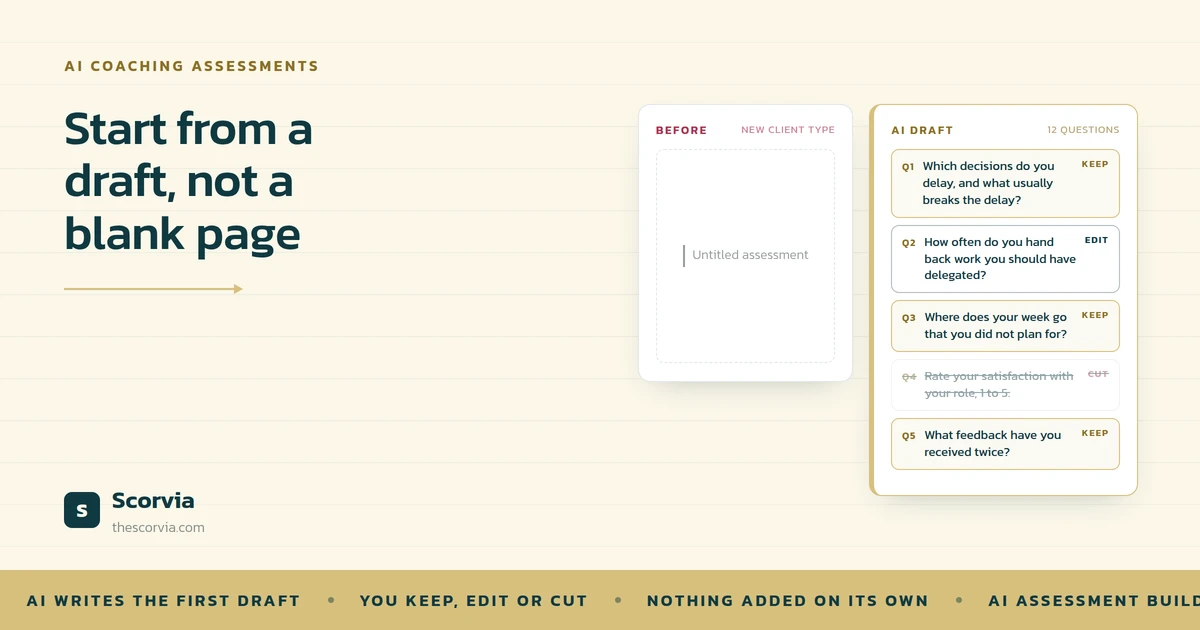
Questions are multiple choice, true/false or open text, mixed in one assessment. Multiple-choice and true/false options can carry a mark; open text stays unscored. A branch can send a client down a different path when an answer changes what to ask next. You keep, edit or throw out every question, and preview the set before anyone gets a link.
Clients answer in writing, or by recording video answers in the browser to up to ten questions. Recordings are transcribed and the transcript becomes the answer. Scorvia transcribes only no facial, tone or emotional analysis, and video answers are not scored.
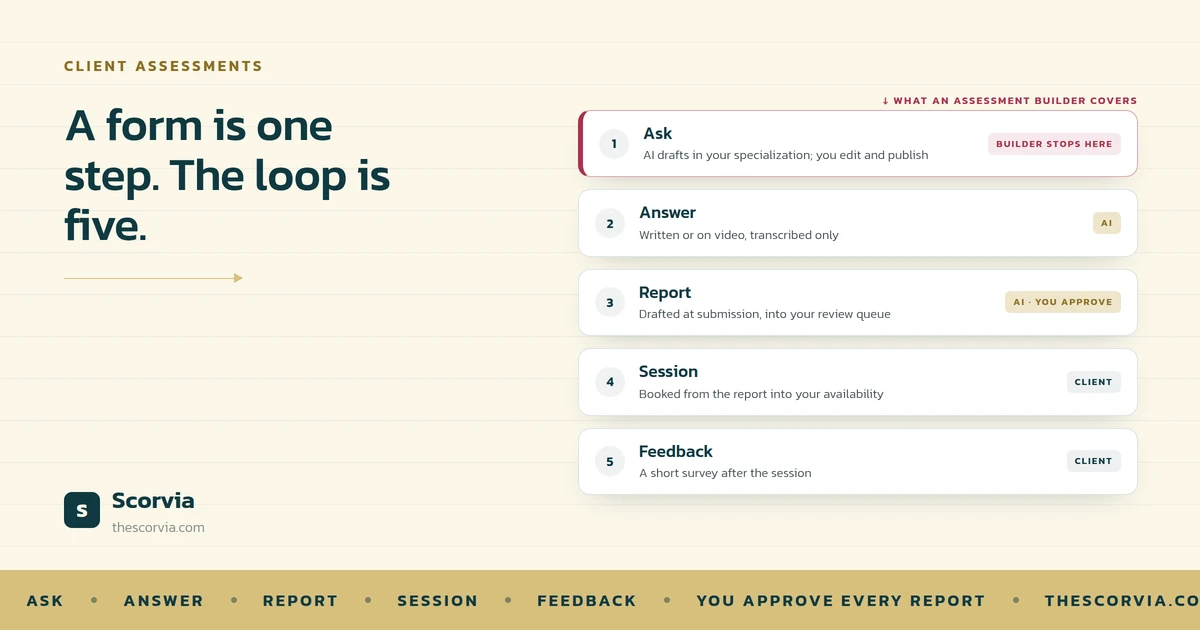
| The client submits | What happens next |
|---|---|
| A draft report is written | Five sections: executive summary, key findings, strength areas, improvement areas, recommendations |
| It lands in your review queue | Marked pending review. Not in the client's inbox |
| You edit | Any section by hand, or ask the AI to redraft one section only. Every version is kept |
| You add a note and approve | Your words at the top. Nothing reaches the client until you do this |
A closer look a sleep-and-routine intake
Take an eight-question intake for a client who wants to sleep better. Here is the shape of it, and what each question is for.
| # | Question | Type · why it is there |
|---|---|---|
| 1 | What would better sleep let you do that you cannot do now? | Open text · the goal in their words |
| 2 | On a typical weeknight, when do you get into bed, and when do you fall asleep? | Open text · the routine as it is |
| 3 | Which of these happen most nights? (screen in bed, caffeine after 3pm, work after 9pm, none) | Multi-select, scored · the habits you will coach on |
| 4 | What have you already tried? | Open text · so you do not suggest it again |
| 5 | When you lie awake, what is usually on your mind? | Open text · the thing they would not have volunteered |
| 6 | How confident are you that you can change your evening routine? (1–5) | Scored · where to start |
| 7 | If 1–2 on question 6: what makes it feel hard? | Branch · only asked when it applies |
| 8 | Is there anything about your sleep you think a doctor should know about? | Open text, unscored · the referral question |
Notice question eight. It is not a coaching question. It is there so that if a client writes something that belongs with a doctor, you see it before the first session, and you refer rather than coach around it.
When this client submits, the draft report already holds their goal, their routine, the scored habits and the confidence score, organised under headings. Your work is the part that needed you: what to make of question five, and what to do first.
With great power: the line the assessment must not cross
An assessment that asks good questions about sleep, stress and habits will sometimes get an answer that is not about coaching at all.
The tool's job is to make that answer visible. Your job is to recognise it. The report does not diagnose, screen or assess risk, it carries no norms or percentile bands, and it is not a substitute for a licensed instrument. If a client discloses something that needs clinical care, that is a referral conversation, not a section of a report.
That is also why nothing reaches a client automatically. The draft goes to your queue. You read every line before you approve it, and on this kind of intake, that reading is the most important thing you do.
The AI drafts the questions and the report. You read, decide and refer. That order is the whole design.
Common questions
How do AI-driven assessments help behavioural health coaches?
By drafting the intake and progress questions in the language of the coach's specialization sleep, stress, habits, routines and by drafting the client report from the answers the moment they are submitted. The coach edits both and approves the report before the client sees it. The AI removes the blank page; the coaching judgement stays with the coach.
Are AI-driven coaching assessments clinical tools?
No. In Scorvia an assessment asks about habits, routines, stressors and what a client wants to change, and the report reflects what they said. It does not diagnose, screen or assess risk, uses no validated norms or percentile bands, and is not a substitute for a licensed instrument. If a client discloses something that needs clinical care, that is a referral conversation, not a report section.
What questions should a behavioural health coaching assessment ask?
Questions whose answers change what you do next: what the client is trying to change, what they have already tried, what a typical week looks like, what gets in the way, and how confident they feel. Multiple choice and true/false for the parts you want to score, open text for the parts you want in their words.
Can clients answer on video instead of typing?
Yes. A client can record answers in the browser to up to ten questions, with nothing to install. Each recording is transcribed and the transcript becomes the answer. Scorvia transcribes only: it does not analyse facial expression, tone of voice or emotional state, and video answers are not scored.
Does the client get the report automatically?
No. The drafted report lands in the coach's review queue, not the client's inbox. The coach reads it, edits any section by hand or asks the AI to redraft one section, adds a note, and approves it. Nothing reaches the client under the coach's name until the coach has read it.