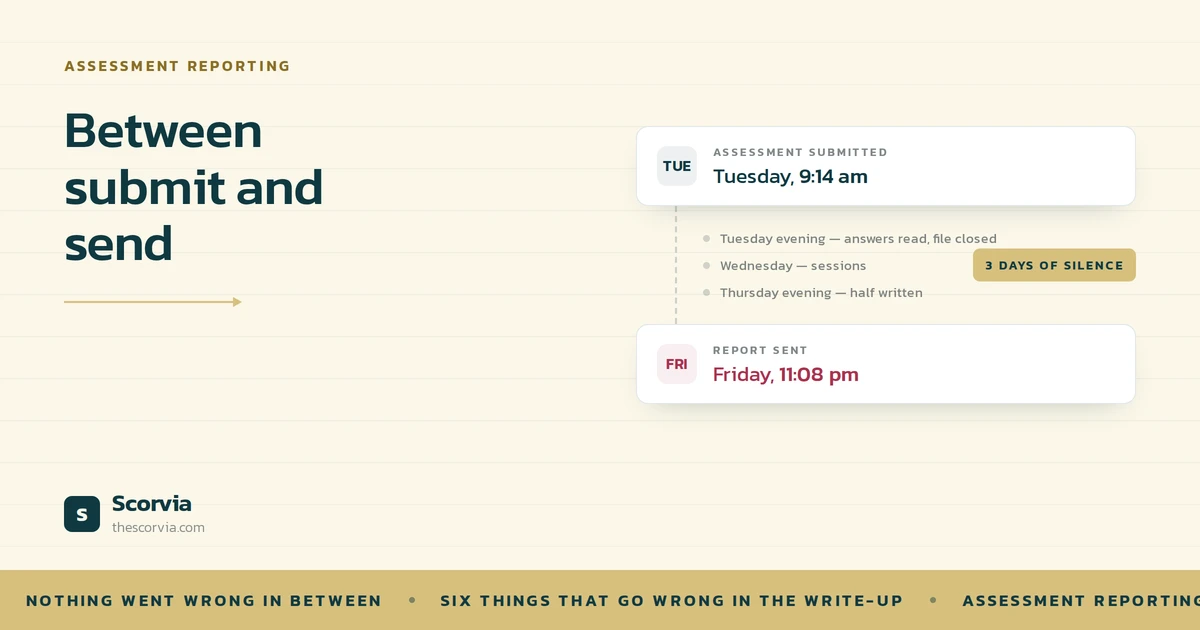
Assessment submitted Tuesday, 9:14 am
Report sent Friday, 11:08 pm
Nothing went wrong in between. No crisis, no emergency, no client who cancelled. The answers were read on Tuesday evening and closed again. Wednesday was sessions. Thursday evening the write-up was half done. Friday it got finished after everything else was, because everything else had a fixed time and the report did not.
That is the gap this piece is about. Not the questions which get most of the attention, but the three days after the answers arrive the part of an assessment that costs a coach the most and that almost nobody describes as a problem, because it just feels like an evening.
Why did nothing go wrong, and why that is the problem
If the delay were caused by something bad, a difficult client, a tool that broke it would get fixed. It is not. It is caused by the write-up being the slowest kind of writing a coach does, and by there being no natural time in a coaching day to do slow writing. So it goes into the evening, every time, and the evening is where care goes to run out.
The client, meanwhile, experiences three days of silence after forty minutes of honest answers. And the coach experiences the same gap as normal, because it has always been three days, and nobody has ever told them it could be three minutes.
Six things that go wrong between submit and send
Not general complaints about admin. Six specific mechanisms, each of which cost you or your client something.
The write-up is the hardest kind of writing, so it waits
The gap between submitting and sending is not laziness. It is that a client report is the slowest writing a coach does: careful, honest about the difficult parts addressed to the person it describes. Nobody does that well in the ten minutes between sessions, so it gets moved to the evening, and then to the next evening, and the answers sit in a folder getting older.
The cost lands on the client, who experiences the gap as silence. They gave you forty minutes of honest answers on Tuesday and heard nothing until Friday, and silence after an assessment reads a particular way not as “the coach is busy” but as “that did not matter as much as I thought”. By the time the report arrives the answers are three days old in their head too, and the session that follows starts by reminding them what they say.
You rebuild the same scaffolding for the fortieth time
Every report has the same shape. A summary, what the answers showed, what is working, what is not, what to do next. That structure has not changed since your tenth client, and yet every report starts from a blank document, which means every report begins with twenty minutes of rebuilding of a frame you have built forty times.
The effort does not accumulate. A coach who has written a hundred reports is faster at thinking and no faster at scaffolding, because scaffolding is typing and typing does not get shorter with practice. What varies from client to client is the content. What you rebuild every time is the part that never varies.
The score and the reason for it live in different places
A client sees a number sixty-two, or “moderate” and asks the only sensible question, which is what drove it. If your marks live in a spreadsheet and the answers live in a form export, answering that means scrolling through both during the session while the client waits. The number is on one screen and the evidence for it is on another, and the join between them is you, in real time.
So the number ends up doing a job it cannot do. It is presented as a finding when it is really a summary of findings that nobody can see, and a client who is told “you scored low on delegation” without being shown which answers produced that has been given a verdict and not an explanation. Most coaches respond by quietly not showing the scores at all, which throws away one part of the assessment that was comparable between clients.
Tone is the expensive part, and it is decided one sentence at a time
The difference between “you struggle with boundaries” and “boundaries are the area with the most room to work in” is the entire report. Same finding, same evidence, and one of them will be read twice while the other is closed and not opened again. Getting that right is not a pass you do at the end. It is decided in every sentence, for the whole document, about a person who reads it alone.
It is also the part of the job that suffers most at the hour it usually gets done. Nobody is at their most careful at ten in the evening after a full day of sessions, and the report is where that shows. The coach who would never say a clumsy thing in a session writes one at 10:40 pm because they were tired and it was true, and the client reads it the next morning with none of the warmth that would have accompanied it in the room.
A fix in one section quietly breaks another
A report is five sections that must be agreed. Rework the recommendations and the summary no longer points at them. Soften the improvement areas and the strengths now read as overstated by comparison. Sharing the findings and the executive summary is suddenly the vaguest thing on the page. Editing by hand puts sections out of step with each other, and you only notice when you re-read the whole thing, which is exactly what you did not have time for.
The first generation of AI writing tools made this worse rather than better. Ask for one paragraph to change and the whole document regenerates, and now the fix you wanted has arrived along with three changes you did not ask for including, usually, the sentence you had finally got right. So, coaches learn to stop asking, and go back to editing by hand, and the tool has helped with exactly one draft.
The thing with your name on it gets the least care
The report is on the artefact. Sessions are remembered; the report is kept, re-read, forwarded to a partner, occasionally shown to an employer. It is the one piece of your practice a client can hold up and point at, and it carries your name and your logo on the front of it.
And it is produced under pressure, at a worse hour, with less review than anything else you do. That is the structural problem underneath the other five. The document that most deserves a careful second read is the one that gets sent at 11 pm without one, because the alternative was sending it on Monday. Every other problem on this list costs you time or a client's patience. This one costs you the thing your reputation is built from, one rushed evening at a time.
What coaches try instead, and why it does not hold
Three reasonable responses, none of which reaches the mechanism.
A report template in Word. Fixes the scaffolding, which was the cheapest of the six. Everything that is slow the organising, the tone, the agreement between sections is still done by hand, still at night. A template is a blank page with headings.
Dictating it. Faster to produce, and now it needs editing, because spoken sentences about a client are not the sentences you would send them. The evening moves from writing to tidying and gets shorter by about a third.
Sending the answers with a covering note. Honest, fast, and it hands the client a spreadsheet and a paragraph instead of a report. It solves the delay by not producing the thing they were waiting for.
What all three share is that they make the coach faster at the write-up. None of them remove the write-up from the coach's evening.
What changes it
The draft must exist before you open the file. Not a template with headings the report, written, from this client's answers, waiting for you.
That is what assessment reporting in Scorvia does. The moment a client submits, their answers become a drafted report: an overall score, a chart a pie for one specialization, bars for several and then the five sections, executive summary through recommendations, written from what they actually said. It lands in your review queue marked Pending review. It does not land in their inbox. On their side they see Under Review, so the three days of silence are replaced by a status.
Then you do the part that was always yours. Read it. Click a bar on the chart and the questions and answers behind that score open, so you can check the number against the evidence in the time it takes to say so. Switch to Edit manually and rewrite anything as text. Or switch to Edit with AI, pick the one section that needs a different tone or more depth, and say so only that section is redrafted, and every other section and your own feedback stay exactly where they were. Every version is kept from the first draft, so a rewrite that came out worse is one click from undone.
Add your feedback a title and a note that appear at the top of the client's report, above your logo and name, before anything the AI wrote. Preview what they will see. Then press Approve & Send, which is the only button that puts the report in front of your client.
Worth being straight about what this does not remove: the reading, the judgement, and the decision to send are still yours, and they still take time. What it removes is the blank page, the scaffolding, and the 11 pm draft. The report that reaches your client is one you read every line of which, if the last five went out on a Friday night, may be a higher standard than the current one.
The draft is waiting when you open the file. Your evening starts at the editing, not the writing.
What to check before you send, whoever drafted it
A short list, because the point of a drafted report is that you have time to use one.
| Check | Why |
|---|---|
| Does the summary point at the recommendations? | The two sections a client reads, first and last, should agree with each other. |
| Can you defend every score in the client's own words? | If you cannot, either hide the score or show the answers under it. |
| Is the hardest sentence one you would say in the room? | Tone written at night is read in the morning. |
| Is your own note at the top? | It is the part only you can write, and the first thing they see. |
If the assessment itself is the thing that needs work before any of this, there is a longer piece of advice on why coaches end up rebuilding the same one every time.
Common questions
Why do assessment reports take so long to write?
Because they combine three slow things: turning raw answers into an organised argument, writing about a person in a way that person can read, and doing it after the day's sessions are finished. None of those gets faster with experience in the way the questions do. The structure is the same every time and the tone must be right every time, so the write-up stays the bottleneck long after everything else in the practice has sped up.
Should an AI write a client's assessment report?
It should draft it, and you should approve it. The draft is the part that costs an evening and follows the same shape every time the summary, the findings, the strengths, the areas to work on, the recommendations. The judgement is the part only you can do whether the tone is right for this client, what the answers do not say, what you noticed in the room. A tool that drafts and then sends without you is the wrong tool. One that drafts and waits is doing the tedious half of your job.
Will my client know the report was drafted by AI?
What your client receives is the report you approved of: every section read by you, any section you rewrote or had redrafted, your own feedback at the top under your name. Whether the first draft was typed by you or drafted for you to edit, the report that goes out is yours because you signed it off. The honest position and the one worth being able to state if asked is that the writing is drafted and the judgement is yours.
What should a coaching assessment report contain?
Five things, in this order: a short executive summary for the client who reads one page, the key findings organised by theme rather than question by question, the strengths named specifically, the areas to work on written so the person can read them, and recommendations they can act on. If the assessment was scored, the scores belong above all of that with the evidence one clicks underneath, not buried in an appendix.
How do I explain the score to a client?
By showing them the answers that produced it. A number on its own is a verdict; a number next to the six questions and the six answers behind it is an explanation, and clients accept explanations. The practical test is whether, when a client asks why they scored what they scored, you can answer with their own words in under a minute. If the answer involves opening a spreadsheet, the score is not ready to be shown.
See how assessment reporting works the draft written on submit, the queue where it waits, the two ways to edit, and the approval that sends it. Or start a 14-day free trial with no card required, answer an assessment yourself, and read what is waiting.