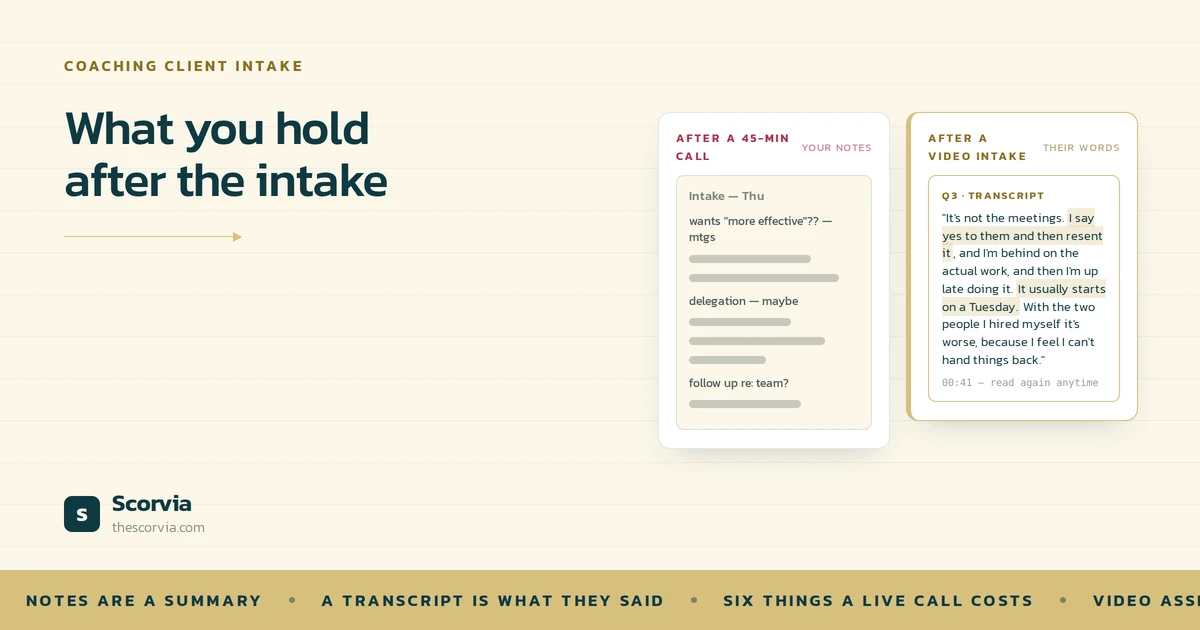
Here is what a coach has after a forty-five-minute intake call:
One page of notes, written while listening, summarising what they think the client said.
And here is what a coach has after a ten-question video intake:
A transcript of what the client said, in the client's own words, that can be read twice.
The first one was the standard way to start a coaching relationship for as long as there has been coaching. The second has been possible for about two years. This is a piece about the gap between them not the gap in technology, which is small, but the gap in what a coach ends up holding.
Why does nobody cost the intake call
Because it does not look like a cost. It looks like the job. A discovery call is where you meet the person, hear the problem, decide whether you can help, and let them decide whether they want you to. Every coach does one. It would feel strange not to.
So, the call is never questioned, and its costs are never added up: the hour, the calendar delay, the notes that replace the conversation, the version of the client who turns up to a first meeting. Each of those is small on its own and invisible because it has always been there. Together they are most of the reason intake is the part of a coaching practice that has changed least in twenty years.
Six things a live intake call costs you
No complaints about calls. Six specific mechanisms, each of which costs you or your client something you need.
1. You give away the most expensive hour you have
Most intake happens on a call, a discovery call, a chemistry call, whatever it is named in your practice. It runs forty-five minutes to an hour, it is unpaid, and it goes to someone who has not yet decided to work with you. Half of them will not. So, the hour that costs you the most, the one you would otherwise sell, is the one you routinely hand out for free to the people least likely to pay for the next one.
Coaches accept this because it feels like the cost of doing business, and for a long time it was. But the thing the call is for finding out what this person needs before you start does not require you in the room for it. It requires the questions to be asked and the answers to be kept. The hour was the delivery mechanism, not the point.
2. Both of you are performing
The first meeting is an audition in both directions. The client is presenting the version of themselves that seems worth coaching, and you are presenting the version of yourself that seems worth paying. Neither of you is lying. Neither of you is being especially honest either, because honesty is not what first meetings are for.
The result is that the intake the one moment designed to find out where someone really is happens under the conditions least likely to produce that. The client who is struggling says they are “fine, just want to be more effective”. The real answer arrives in session three, once they trust you, and the first two sessions were spent getting to the place a good intake should have started from. A question answered alone, with a camera, with nobody watching the reaction, gets a different kind of answer.
3. A conversation cannot be replayed
What you have after an intake call is your notes. Your notes are a summary, written while you were also listening, thinking of the next question, gauging whether this person was a fit and, in some part of your mind, selling. They are the best you could do with a third of your attention, and they are all that survives.
The thing the client said is gone. The phrasing, the example, the qualification they added halfway through a sentence the material you would build the first session on exists only in the version of it you had time to write down. You cannot go back to it, and you cannot read it twice. Every other document in your practice can be re-read. The intake, the most important one, is the only one that cannot.
4. The calendar decides when coaching starts
A client's motivation is highest on the day they enquire. That is when they have decided something needs to change and gone looking for help. And the first thing the process does with that motivation is ask them to find a time which means comparing calendars, working around time zones, and often one reschedules, so that the intake happens ten days later, and the first real session a week after that.
By then the urgency that made them write to you has cooled into a diary entry. Nothing about the intake needed to be synchronous. It needed the client to answer some questions and you to read the answers, and neither of those must happen at the same time as the other. The calendar is in the middle of it only because a call was the tool.
5. It stops working the moment you are not the only coach
One coach, one intake calls at a time, is practice. Three coaches sharing clients, or a training company onboarding a cohort of twenty, is not, and the live intake call is the first thing that breaks. Nobody can run twenty discovery calls in a week and still deliver sessions, so the intake gets shortened, delegated to whoever is free, or skipped in favour of a form that nobody reads.
What a team needs is an intake that produces the same thing for every client regardless of who was available that day: the same questions, asked the same way, answered in the client's own words, kept somewhere every coach on the account can read. A live call cannot be that, because a call is only ever as consistent as the person on it, and only exists in that person's notes afterwards.
6. Your memory is the database
After thirty clients, what you know about them at intake lives in three places: your notes, scattered across whatever you were using at the time; your inbox, where the enquiry email is; and your head, which is where most of it is. None of the three is searchable across clients. If you wanted to know how many of your last thirty mentioned the same thing at intake, you would have to remember, and you would be wrong.
That matters more than it sounds, because the pattern across your intakes is the most valuable thing your practice generates, it is the difference between a coach with thirty clients' worth of experience and a coach with thirty separate anecdotes. A live call feeds the second. It gives you a good conversation and then it is over, and what it taught you about your clients as a group is left to whatever your memory keeps.
What coaches try instead, and why it does not hold
Three reasonable responses, none of which reaches the mechanism.
•A shorter call. Twenty minutes instead of forty-five. You still give it away, it still needs a calendar, both of you still perform, and now you have less to show for it. The cost per call is lower and the cost per client is the same.
•A written form before the call. Better, and a lot of coaches land here. But typed answers are the thin version of what a client would say there is a whole piece on that, and the call still must happen afterwards, so you have added a step rather than removed one.
•An assistant does the intake. This solves your hour by spending someone else's, and it makes the notes problem worse: now the summary was written by a person who will not be in the sessions.
What all three share is that they keep the call and try to make it cheaper. None of them asks whether the call was the right tool for the job the intake is doing.
What changes it
Separate the two things a discovery call was doing. One was finding out where the client was. The other was a conversation about the part that needs two people. Give the first one to the client to do alone and keep the second.
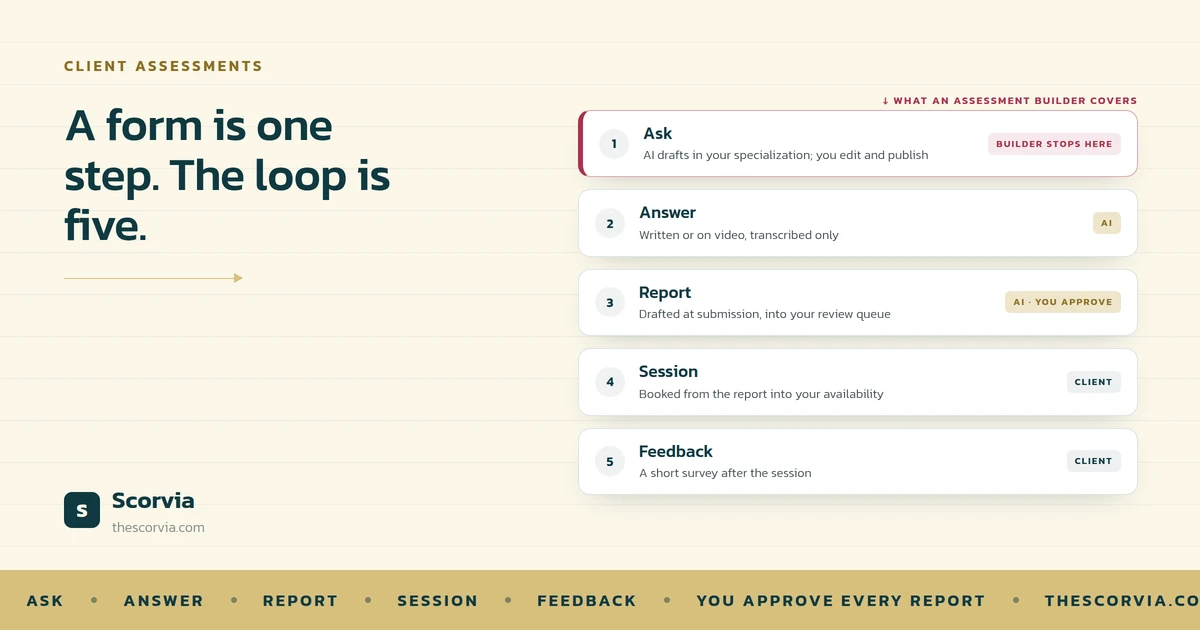
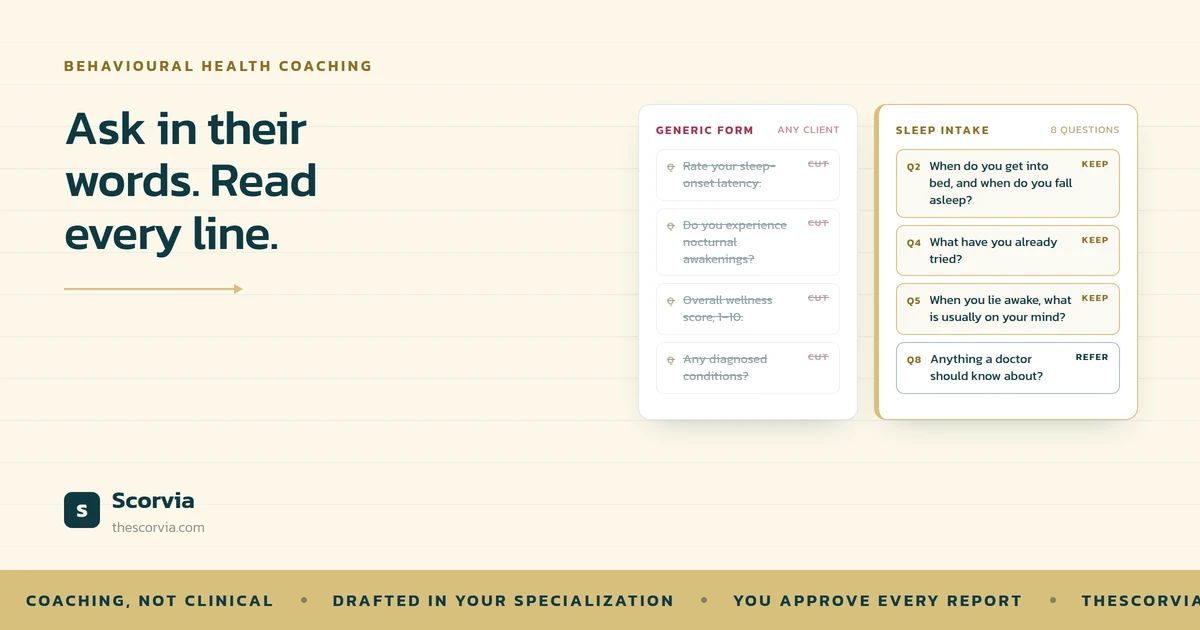
In Scorvia that is the AI video assessment builder. You write up to ten questions, or let the AI draft them for the specialization you work in. The client opens the assessment through their own login nothing to install on a laptop or a phone and records an answer to each question live in the browser, in their own time, on the day they enquired if they want to. No calendar. Nobody watching them answer.
The AI converts each recording to text, and the transcript becomes the client's answer. That transcript feeds a drafted report which lands in your review queue, not the client's inbox. You read what they said twice, if you like edit the report, add your note, and approve it. Nothing reaches the client under your name until you have read it. And because every client in a specialization answers the same ten questions, the transcripts sit side by side in your account where any coach on it can read them, and the pattern across thirty intakes is something you can look at rather than something you have to remember.
What the AI does not do, because it is the first thing anyone sensible asks: it transcribes. No facial expression, tone of voice or emotional state is analysed. Nothing infers mood from a face or stress from a voice. Video answers are not scored. It is a coaching intake that uses video to get a fuller answer, not a screening tool that rates how someone comes across.
The client answers on the day they enquire. You read the transcript before the call. The call starts from page two.
What still needs a call
The conversation. Chemistry, whether you like each other, whether the way you work suits the way they think. None of that comes through a transcript, and no one is suggesting it should.
What changes is that the call is now spent on that, rather than on the twenty minutes of questions a client could have answered alone. It is shorter, it starts from what they said instead of from zero, and both of you arrive knowing something. That is a better first meeting, not a replaced one.
If your intake is currently a written form rather than a call, the problems are different and there is a separate piece on those.
Common questions
What is an AI video assessment for coaching intake?
A set of questions a prospective or new client answers by recording themselves, in their own time, before the first session. The recordings are transcribed and the transcript becomes their answer, so the coach reads what the client said rather than notes from a call. In Scorvia a video assessment holds up to ten questions, is answered in the browser with nothing to install, and produces a drafted report for the coach to review.
Does video intake replace the discovery call?
It replaces the part of the call that was intake the twenty minutes of finding out where the client is and leaves the part that was a conversation. Most coaches still have a first call. It is shorter, it starts from a transcript rather than from zero, and it is spent on the things that need two people in a room instead of on questions a client could have answered alone.
Is it strange to ask someone to record a video before we meet?
Less strange than the alternative once you think about it. A live call with a stranger is the more exposing of the two: the client is watched, in real time, while forming answers. Recording alone, with the option to stop and start again, is closer to writing a considered reply than to an interview. Tell them how long it takes, what happens to the recording, and that you will read it before you speak those three things are what makes people comfortable.
Can video intake work for a group or a cohort?
Yes, and this is where the difference from a live call is largest. Twenty people can answer the same ten questions in the same week without twenty calls being scheduled, and every coach on the account can read every transcript. A cohort intake that would have taken a fortnight of calendar management takes the time it takes twenty people to record.
What does the client get after recording?
A report, once the coach has read and approved it. The transcript feeds a drafted report that lands in the coach's review queue, not the client's inbox. The coach reads it, edits what needs editing, adds a note, and shares it. So the client's intake produces something they can hold the first written thing about their situation rather than a call that ended with “great, I will be in touch”.
See how the video assessment builder works up to ten questions, recorded in the browser, transcribed, and a report you approve before anyone sees it. Or start a 14-day free trial with no card required and record an intake answer yourself.