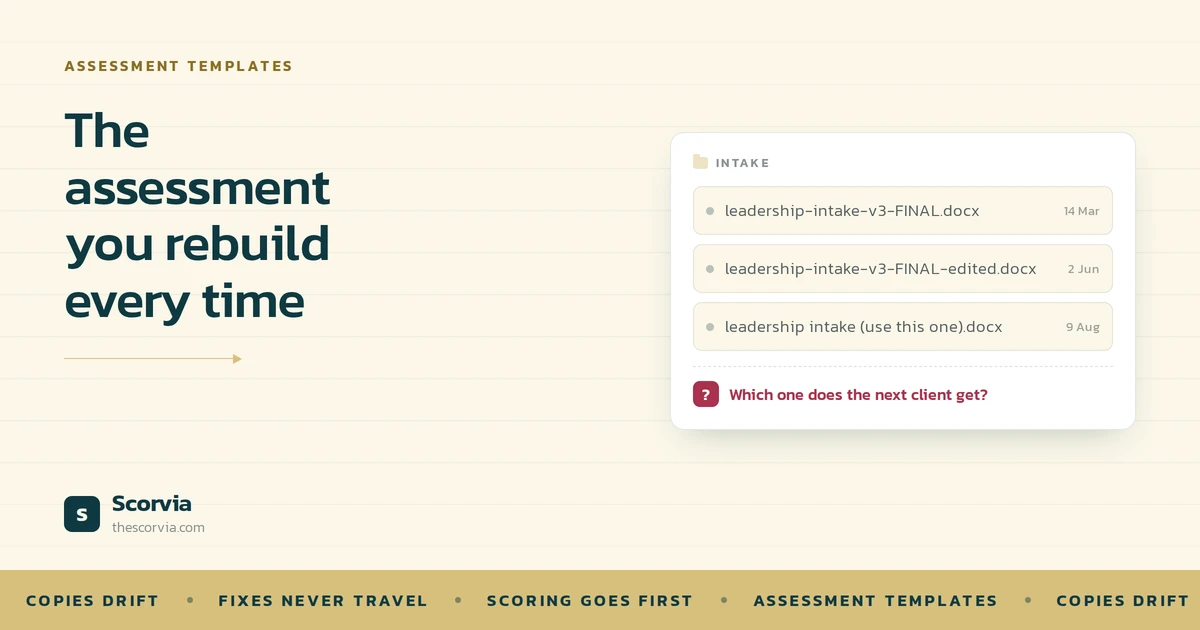
Three files, in the folder where you keep your intake:
leadership-intake-v3-FINAL.docx
leadership-intake-v3-FINAL-edited.docx
leadership intake (use this one).docx
One of them is the version you would want the next client to get. You do not know which, and opening all three will not settle it, because each one has something the others do not a better question three, the scoring you worked out in March, the two follow-ups you added for the client who managed a team of forty.
This is not a filing problem. It is what happens when the thing you rely on most is a document you copy rather than an asset you own.
Why nobody notices this is happening
Because every individual copy is fine. You open it, it makes sense, the questions are good, the client answers them. Nothing in front of you at that moment says the assessment has drifted, because drift is not visible inside a single document only across them, and you never see them side by side.
So the cost lands somewhere else entirely. It shows up as first sessions that take longer than they should, as clients who answer something other than what you asked, as the vague sense that your intake used to be sharper than it is now. None of those get traced back to the folder, because the folder looks like admin and those look like coaching.
Six things that break when you copy instead of reuse
Not general complaints about documents. Six specific mechanisms, each of which costs you something you need.
Every copy is slightly worse than the one before it
Nobody decides to degrade their own assessment. It happens because every copy is edited under pressure. You duplicate the last client's document the night before the call, strip out their name, notice a question that does not apply, delete it, add one that does, and send it. Each of those edits was correct in the moment and none of them was made with the next twenty clients in mind.
Three generations later the assessment drifted somewhere nobody chose. The question you cut for a client who did not manage anyone is gone for everyone. A question you added for one unusual case is now asked of people it confuses. The document still works, it is coherent, it produces answers which is exactly why nobody goes back and checks it. A thing that is visibly broken gets fixed. A thing that is quietly two per cent worse every time does not.
Your best fix never reaches the next client
This is the one that costs the most and shows the least. Halfway through a session you realise question four is badly worded, the client answered something other than what you meant, and now you know exactly how to phrase it. So, you fix it, in that client's copy, because that is the file you have opened.
The next client starts with a different copy. Your fix is not in it. Everything you learn about your own assessment the question that always gets misread, the one nobody answers, the one that turns out to matter more than you thought stays trapped in the single document where you learned it. Over two years that is dozens of real improvements, each one made once and then lost. The assessment you are sending today is not the best version you have ever written. It is just the most recent one.
Scoring is the first thing to go
Deciding what an answer is worth longer than writing the question. Which options carry weight, how much, whether three moderate answers should add up to more than one severe one that is real thinking, and it is the part that does not survive a copy-paste. A duplicated document keeps the words and loses the arithmetic.
So scoring gets rebuilt from memory, which means it is inconsistent, or it gets dropped, which means it is gone. Both outcomes cost the same thing: you can no longer say that this client scored higher than that one, because they were not marked on the same scale. And the moment scores stop being comparable, the charts and totals in front of a client are decoration rather than measurement which is worse than having none, because a number on a page reads as fact.
The order you arrived at is invisible, so it erodes
Question order is a design decision that leaves no trace. You worked out over a couple of years that the factual question goes first because it gets people moving, that the one needing real reflection lands better at position four than position one, and that anything sensitive belongs after the client has warmed up. None of that reasoning is written anywhere. It is just the order the document happens to be in.
Which means the first time someone reorders while editing you, in a hurry, or an assistant coach adapting it the sequence goes, and nothing flags it. The assessment still contains every question. It just asks them in an order nobody thought about, and the client who gets asked the hard one first gives you a shorter answer to it. You will not trace that back to the reorder, because the reorder was never a visible event.
Without branching, you choose between too long and wrong for half of them
A static document cannot ask different people different questions, so you get two options and both are bad. Ask everyone everything, and the assessment runs to forty questions of which a given client can meaningfully answer twenty-five, so they wade, they tire, and the last answers are worthless. Or trim it to what most people need, and the clients who do not fit the average get an assessment that misses their situation entirely.
The usual workaround is worse than either. You write instructions into the document skip questions eight to twelve if you do not manage a team and now the client is doing your logic for you. Some follow it, some ignore it, some answer anyway because skipping feels like not trying. When the answers come back you cannot tell a question that was deliberately skipped from one that was abandoned, and a blank that might mean two different things is not data.
You cannot compare your own clients, so you cannot see your own patterns
This is the structural one, and it only appears once you have been doing the work for a while. After twenty clients in a specialization, you are the person best placed to notice what they have in common, the thing nearly everyone underestimates, the answer that almost always predicts a hard second month. That is the most valuable thing your practice generates, and it is the reason experienced coaches are worth more than new ones.
But it is only visible if twenty people were asked the same questions in the same way. If each of them got a slightly different document with slightly different wording and no consistent scoring, you have twenty individual conversations and no pattern. The information exists. It is just distributed across twenty files in a form that cannot be added up. Every other problem on this list costs you time; this one costs you the compounding return on your own experience, which is the only asset in a coaching practice that should be more valuable every year.
What coaches try instead, and why it does not hold
Three reasonable responses, none of which fixes the mechanism.
A master document you never send. The right instinct, and it works for about four months. It fails because the master is only as current as your discipline on a Tuesday night, and the edits that matter most are the ones you make while you are with a client in their copy, not in the master.
Naming conventions and a shared drive. This solves “which file is current”, which was the least expensive problem on the list. It does nothing about scoring, sequence or branching, because none of those are things a filename can hold.
Cloning a form instead of a document. Closer, and it does keep the question wording intact. But a cloned form is still a copy: the clone and the original are now separate things that drift apart exactly the way the documents did, and most form tools cannot carry weighted scoring or real conditional logic anyway.
What all three have in common is that they manage copies better. None of them stops there being copies.
What changes it
Stop treating the assessment as a document and start treating it as a template one thing you edit, not a lineage of files you duplicate.
In Scorvia that is the assessment template. You name the specialization you work in and the AI drafts a question set in that field's language, with scoring suggested on the questions that can carry a mark. You keep the good questions, rewrite the ones that are close, delete the rest, drag them into the order you want them to ask, and set the branching so a multiple-choice or true/false answer sends different clients down different paths.
Then you save it, and that is the assessment. Not a copy of it. The questions, the question types, the marks and their weighting, the sequence and the branching are all held together, so the next client starts with the finished thing rather than from whichever file you opened last.
Which also means your improvements finally have somewhere to go. The question you rewrite after a session is rewritten once, in the template, and every client after that gets the better version which is the whole difference between an assessment that decays and one that compounds.
Worth being straight about the cost: the first build in each specialization is real work. You decide what you want to know about a client before you meet them, and no software does that part for you. What the AI removes is the blank page and typing an evening's writing becomes an hour's editing. You pay that once per specialization, not once per client.
One template per specialization, edited in one place. Not fourteen files and a guess about which is current.
What to keep in the template, and what to vary
A template is not an argument for treating every client identically. It is an argument about where the difference belongs.
| Keep in the template | Vary per client |
|---|---|
| The question wording | Which branch they end up on |
| The scoring scale and weighting | What you do with the score in session |
| The order questions are asked in | The note you send with the invitation |
| The follow-ups behind each branch | Which template you assign in the first place |
The rule underneath it: anything that has to be comparable between clients belongs in the template, and anything that is genuinely about this person belongs in the conversation. Editing the questions for each client puts the difference in the one place where it costs you the ability to compare, which is the opposite of what anyone intends.
If the questions themselves are what need work first, there is a longer piece on what written answers lose and why.
Common questions
What is a coaching assessment template?
An assessment you build once and reuse, rather than a document you copy and edit each time. A real template holds more than the questions: the question type, any scoring you attached, the order they are asked in, and the branch between them. That last part is what separates a template from a saved file, a file keeps the words, a template keeps the logic.
Why does copying my last assessment stop working?
Because copies drift and improvements do not travel. Every duplicate is edited under time pressure for one client, so changes made for that client stay in the assessment for everyone, and fixes you work out mid-session never reach the next person. After a few rounds nobody can say which copy is the good one, and the answer is usually that none of them is.
Should every client really get the same assessment?
The same assessment, not the same experience. Everyone in a specialization should be asked the same well-designed questions in the same order and scored on the same scale otherwise their answers cannot be compared, including by you. Where clients genuinely differ, that belongs in conditional branching inside the assessment, and in what you do with the answers, rather than in a differently edited document each time.
How many assessment templates does a practice need?
Usually, one per specialization you work in, not one per client. A coach doing leadership and career transition needs two good templates, not fourteen variations. If you find yourself wanting a new template for a particular client, that is nearly always a sign the existing one needs a branch rather than a copy.
Does using a template make an assessment feel impersonal?
It has the opposite effect, because of where the personalisation moves. The questions are the part that should be consistent; what makes an assessment feel personal is that they were the right questions, asked in a sensible order, with the follow-ups that apply to this client and not to everyone. A rushed edit of last client's document is not personal it is just inconsistent.
See how assessment templates work AI drafts the questions for your specialization and suggests the scoring, you set the sequence and the branching, and you build it once. Or start a 14-day free trial with no card required and build the first one tonight.