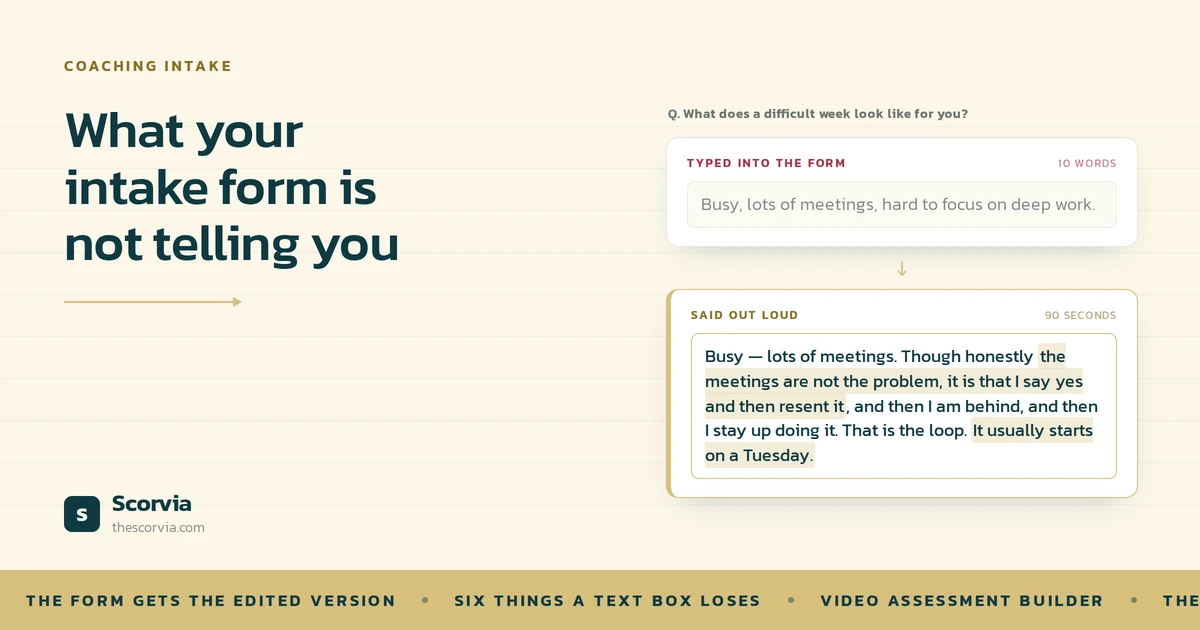
Here are two answers to the same intake question. The question is: what does a difficult week look like for you?
Written: “Busy, lots of meetings, hard to focus on deep work.”
Spoken: “Busy lots of meetings. Though honestly the meetings are not the problem, it is that I say yes to them and then resent it, and then I am behind on the actual work, and then I stay up doing it and I am useless the next day. That is the loop. It usually starts on a Tuesday.”
Same client. Same question. The first one is a form field. The second one is ninety seconds of someone talking.
The written answer is not wrong. It is accurate, brief, and completely unusable — there is nothing in it to coach. The spoken answer contains the pattern, the client's own read on the pattern, and the moment it starts. You would build the whole first session on it.
Why this is almost impossible to notice
The awkward part is that you only ever receive the edited version. The thinner answer does not arrive marked as thin. It arrives looking like a complete answer, because the client did answer the question, they just answered the version of it that fitted a text box.
So, the intake feels fine. It is complete. Every field is filled. And then you get to the first session and spend forty minutes asking questions you thought the form had already covered, because what you received was a summary of the client's situation written by someone in a hurry.
Coaches generally blame the questions when this happens and rewrite them. Sometimes that is right. More often the questions were fine, and the format ate the answer.
Six things a written intake form quietly loses
Not a list of complaints about forms. Six specific mechanisms, each of which costs you something you need.
The answer gets edited before you ever see it
This is the big one, and it is invisible because you only ever receive the edited version. A client types a sentence, reads it back, decides it sounds worse than they meant, and trims it. What arrives is the version that survived their own review accurate, defensible, and missing the part that was actually useful. Nobody does this on purpose. Writing simply gives people a redraft they would never get in conversation, and they take it.
What gets cut is predictable, which is what makes it expensive. The first thing to go is the admission the clause where the client concedes their own part in the problem. The second is the specific example, because naming a colleague or a week in writing feels like putting something on the record. Both of those are the material you would have opened the first session with, and both are exactly what a client will say out loud without a second thought. You are not losing volume. You are losing the two categories of answer you most needed.
Length collapses to the effort the box demands
A text field is an implicit instruction about how much to write, and almost everyone reads it as “not much”. Ask what a difficult week looks like and you get two lines, not because the client has two lines' worth of material but because typing five paragraphs on a phone at half past nine is work. The same person will talk for ninety seconds without noticing. What you lose is not detail; it is the example, and the example is what you coach.
This is why making the box bigger does not help. The constraint is not the field size, it is the typing, and a larger box only makes a short answer look more obviously short. It also explains a pattern most coaches will recognize from their own forms: the first two open questions get real answers and everything after that gets progressively shorter, until the last one is a single word. That is not the client losing interest in your questions. It is a person running out of patience with a keyboard.
You lose the qualification, which was the finding
People rarely answer a question about their own behaviour flatly. They answer it and then correct themselves: “though that is mainly when I am covering for someone”, “which sounds worse than it is”. Those clauses are where the real situation lives. In writing they almost never survive, because a qualification reads as waffle to the person typing it and they cut it. In speech it arrives automatically, and it is usually the sentence you build the session on.
The cost here is not a thinner answer, it is a wrong one. “I struggle with delegation” and “I struggle with delegation, though only with the two people I hired myself” send you to two different places, and the written form gives you the first. You spend a session working on a general capability when the actual issue was two specific relationships. Nothing in the intake told you that, and nothing in it told you the intake was incomplete either.
Order and hesitation disappear
What someone mentions first, what they circle back to, where they pause before answering — none of that exists in a text box. A written form flattens every answer to the same confident register, so a question the client found genuinely difficult looks identical to one they answered without thinking. You have the content and none of the weighting.
In the first session you read that weighting constantly without calling it a technique. The question that gets a long breath before the answer is the one you slow down on. The topic the client returns to unprompted three times is the topic, whatever they wrote on the form. A written intake strips all of it out and hands you six answers of apparently equal importance, which means you arrive at the session with information but no priority — and you spend the first half of it working out by conversation what the intake was supposed to have told you.
Half-finished forms, and the half you lose is the end
Long written intakes get abandoned, and they get abandoned in a specific place: the open-text questions near the end, which are the ones you cared about most. The client who quits at question eighteen has answered all your multiple choice and none of your “describe a time when”. You are left with the demographics and none of the substance.
Then there is the follow-up, which costs more than the form did. You email, they apologise, they finish it a week later in five minutes flat, and that version is thinner than what you would have got on the first attempt. Meanwhile the first session has either been pushed back or goes ahead on half an intake. Coaches usually record this as a client engagement problem. It is more often a format problem: the assessment asked for forty minutes of typing from someone who had twenty.
The write-up still lands on you
Even when the form works, you are holding a page of raw notes that has to become something a client can read. That is the evening nobody counts when they say the intake process is “just a form”. The form was the cheap part. Turning it into a report you would put your name on is the part that caps how many clients a practice can carry.
And it is the problem that gets worse as the intake gets better. Richer answers mean more to read, more to synthesise, more to write up so the coach who fixes the first five problems inherits a bigger sixth one. That is the trade most practices settle into without ever deciding to: a shallow intake that is quick to process, chosen over a deep one that is not. It is a reasonable decision made for the wrong reason, and it is the one worth revisiting, because it is the only one of the six that is a capacity problem rather than a format problem.
What coaches try instead, and why it does not fix it
Three common responses, all reasonable, none of which address the mechanism.
•Longer forms. More questions produce more short answers and more abandonment. You have increased the volume of the thing that was not working.
•Better question wording. Genuinely helps and is worth doing a leading question gets a defensive answer in any format. But the best-worded question in the world still arrives in a text box, and the box still gets the edited reply.
•A discovery calls instead. This does solve it, and it costs you an hour per client plus scheduling, plus you are now taking notes during the conversation instead of listening to it, plus nothing is written down in the client's own words afterwards.
The pattern in all three: they either keep the format that caused the problem, or they fix it by spending an hour you do not have.
What changes it
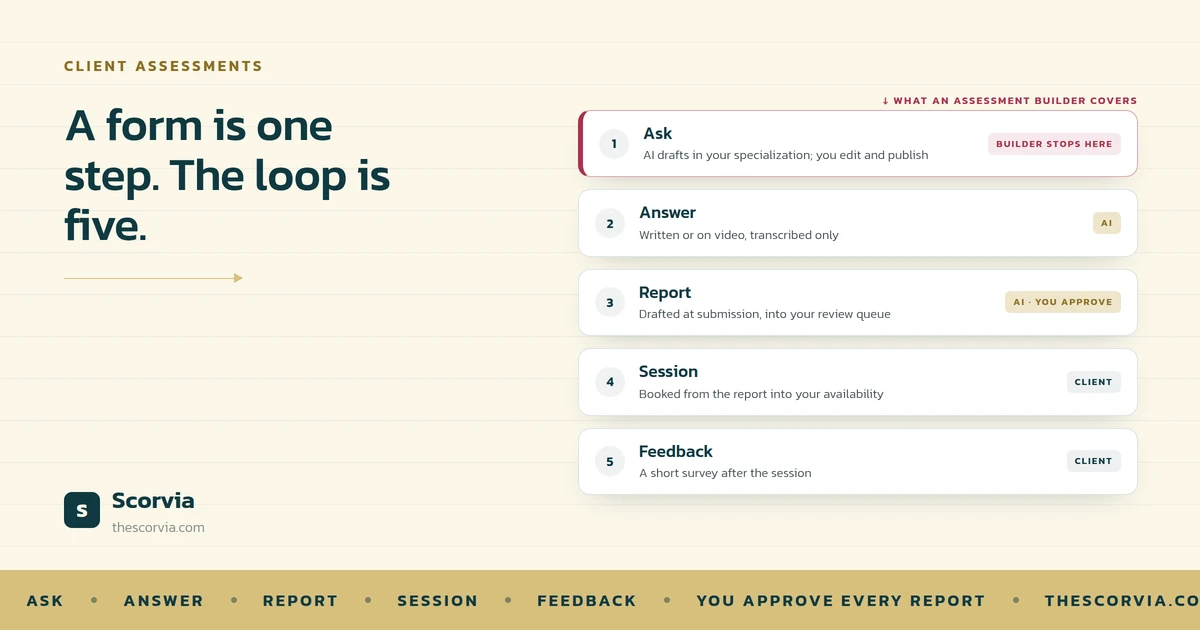
Let the client answer out loud, in their own time, and have the words written down for you.
That is what a video assessment is. You ask the questions in advance, the client records an answer to each one whenever suits them, and the recording is transcribed so you get the text. No call to schedule, no notes to take, and none of the editing that happens between a client's thought and a typed sentence.
In Scorvia this is the video assessment builder. You build up to ten questions write them yourself or let the AI draft a set for the specialization you work in. Your client opens the assessment through their own login and records each answer live in the browser, on a laptop or a phone, with nothing to install. The AI transcribes each recording, and the transcript becomes their answer.
Then the sixth problem gets handled too: the report is drafted from those transcripts. Executive summary, key findings, strength areas, improvement areas, recommendations waiting in your review queue rather than your client's inbox. You rework what needs reworking, add your coach note, approve it, and share it. The evening disappears; the judgement stays yours.
Which questions to move, and which to leave alone
Video is not better than writing. It is better for a particular kind of question, and worse for others.
| Move to video | Leave in writing |
|---|---|
| “Describe a time when…” | Anything factual or numeric |
| “Walk me through what happened” | Multiple choice you want scored |
| “What does a bad week look like?” | Questions you will compare over time |
| Anything where the example is the point | Anything a client would answer more honestly in private text |
| The one question you always end up re-asking in session | Long lists, availability, logistics |
Most practices end up running both: a short video assessment at intake where hearing someone matters, and written assessments for the progress checks they want to measure. Scorvia caps a video assessment at ten questions and for exactly this reason ten recorded answers is already most of an hour of a client's attention, and the value is concentrated in the first five or six.
If your questions themselves need work before any of this, there is a longer piece of wording them so clients answer honestly.
Common questions
Are video answers better than written ones?
Not universally — they are better for a specific kind of question. Anything beginning “describe”, “walk me through” or “tell me about a time” gets a fuller answer spoken than typed. Anything factual, comparative or scored is better in writing, where a client can be precise and you can measure it. Most practices end up using both, and the skill is knowing which question is which.
Will clients record themselves?
More readily than most coaches expect, provided three things are true: they know roughly how long it will take, they can do it in their own time rather than on a call, and they know what happens to the recording. Told those three things up front, recording is usually less effort for a client than writing — talking is the thing they already know how to do.
Does the AI judge how someone comes across on camera?
No. The recording is transcribed, and the words are what the AI works from and what you read. Nothing analyses facial expression, tone of voice or emotional state, and nobody is scored on delivery. This is a coaching assessment that uses video to get a fuller answer, not a screening tool that rates how someone presents.
How many video questions should an assessment have?
Fewer than a written one. Scorvia caps a video assessment at ten questions, and most of the value sits in the first five or six ten recorded answers is already most of an hour of a client's attention. Pick the questions where hearing the answer genuinely changes what you understand and put everything else in a written assessment.
What happens to the recording after the client submits?
It is transcribed, and the transcript becomes the client's answer. The report is drafted from those transcripts and lands in your review queue rather than the client's inbox, so you read it first. You rework any section, add your coach note, approve it, and then share it.