An ADHD coaching assessment is a set of questions a coach sends a client about how their days run: where focus holds and drops, which routines exist and which collapse, and what happens between deciding to do something and doing it. It informs the coaching plan; it does not diagnose ADHD, screen for it, or assess risk. In Scorvia, you set the specialization to ADHD coaching, the AI drafts the questions in the client's language, you edit, score and branch them, and the report is drafted into your review queue the moment the client submits.
The question ADHD coaches are asking
The question is what to ask a new client, when the one thing you cannot ask is whether they have ADHD.
Many clients arrive with a diagnosis. Some arrive with suspicion. Either way, the diagnosis is not the coaches to make, and an intake that reads like a screening form says otherwise.
The useful question is different: how does this client's week actually run? That is what an ADHD coaching assessment asks.
The problem: borrowed screening questions
The problem is that most ADHD coaching intakes borrow their questions from screening instruments, and then try to coach from the answers.
A screening question asks a client to rate how often they feel restless. The answer tells a clinician something; it tells a coach nothing about Tuesday.
It also puts the coach in the wrong place. A form full of symptom ratings implies an assessment of ADHD, which a coach is not qualified to make and should not appear to be making.
And the client has done it before. Clients with a diagnosis have filled in the screening forms; another one is a reason not to finish.
A coaching assessment asks about the week, not the condition. That is the whole difference, and it is a difference of kind, not degree.
The solution: ask about focus, routines and follow-through
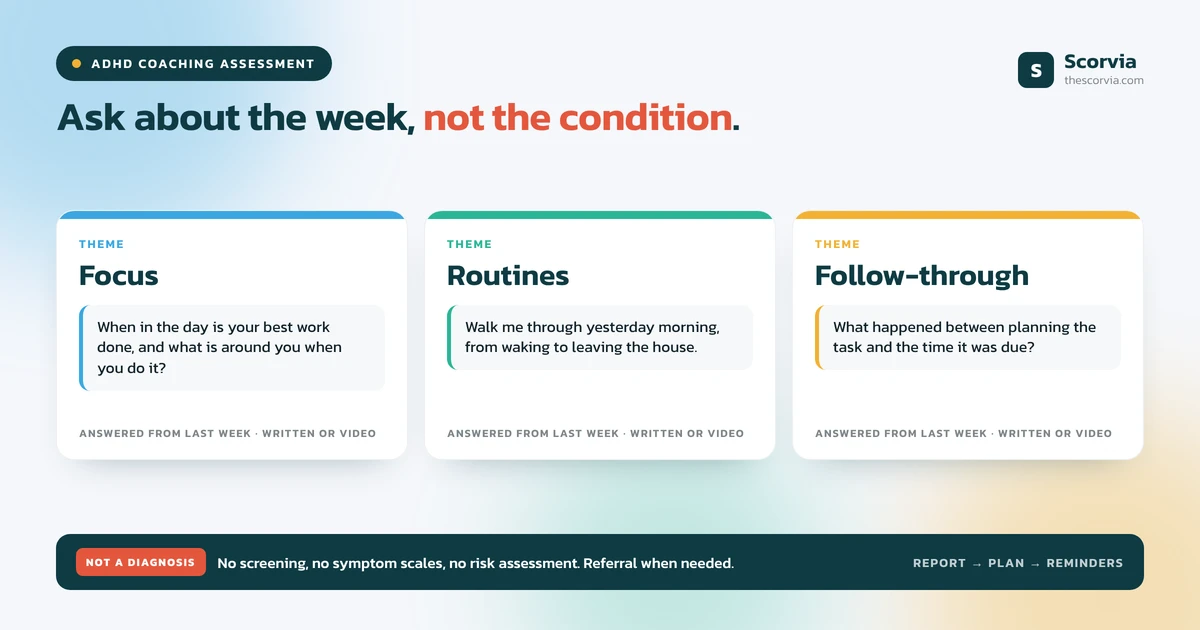
The solution is to ask only what a client can answer from their own days, on three themes.
Focus: when in the day it is easiest and hardest, and where it goes. Routines: which ones happen without effort, which collapse, and what the morning actually looks like. Follow-through: what happens between deciding to do a task and starting it, and what has ever helped.
Every answer is something the coach can build a plan around. Nothing is a symptom. That is the shape Scorvia's assessment builder drafts when you set the specialization to ADHD coaching.
Example questions, by theme
These are the kind of questions that belong in the assessment. Each one can be answered from last week.
Focus
At what time of day do you get your best work done, and what is usually around you when you do? What is the first thing that pulls you off a task once you have started it? When focus goes, what do you do next?
Routines
Walk me through yesterday morning from waking to leaving the house. Which parts of your week happen at the same time every time? Which routine have you tried to build in the last year, and what happened to it?
Follow-through
Think of a task you planned this week and did not start. What happened between planning it and the time it was due? What has ever helped you start something you were avoiding: a list, a timer, a person, a place? What would make the next two weeks easier?
Those are written in the client's language on purpose. How to word questions so clients answer them honestly is covered in how to write assessment questions.
How to build an ADHD coaching assessment in Scorvia
Seven steps, in the order they happen.
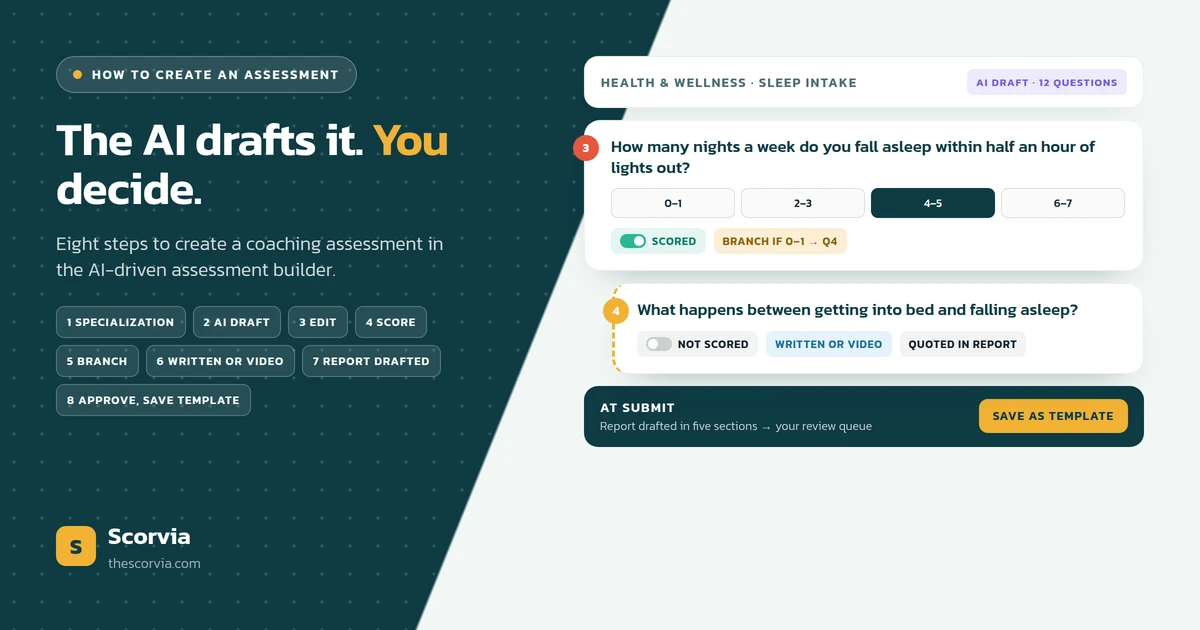
1. Set the specialization to ADHD coaching
Name the field before you write a question. Scorvia lets you create your own categories and specializations, and everything the AI drafts afterwards is written for ADHD coaching, in the words your clients use about their own days.
2. Let the AI draft the question set, then cut it to three themes
Ask for an intake on focus, routines and follow-through. Keep the questions that ask what happens, delete any that ask the client to rate a symptom, and rewrite anything a client would need a definition to answer.
3. Score the questions that can be compared next time
A closed question about how many mornings a week a routine happens can carry a score. A question about what gets in the way cannot. Score the first kind, leave the second open, and plan to quote it in the report.
4. Add a branch so the client only sees what applies
If a client says they have no fixed start to their day, do not ask what time it starts. Conditional branching keeps the intake short, which matters more for this client group than for most.
5. Let the client answer in writing or on video, one question at a time
Clients answer online with nothing to install and can save and finish later. For a client who talks more easily than they type, allow a video answer; the recording is transcribed and the transcript becomes the answer.
6. Read the drafted report and approve it
The moment the client submits, a report is drafted into your review queue: summary, findings, strengths, areas to work on, recommendations. Edit it, add a note in your own words, and approve. The client sees Under Review until you do.
7. Turn the report into a plan with reminders
The findings become goals and the recommendations become daily tasks, with repeat rules and a time of day, in the client's own calendar. Reminders and check-ins run on a cadence you set, and progress comes back without you chasing it.
What a coach asks, and what belongs to a clinician
The line is simple to state and worth putting on the page the client sees.
| A coach asks | A clinician assesses | |
|---|---|---|
| The question | How does your week run? | Do you meet the criteria for ADHD? |
| The instrument | A coaching assessment the coach built, in the client's language | A validated instrument with norms, used by a qualified clinician |
| What is scored | Routines: how many mornings a week, how often a planned task starts | Symptoms, severity and impairment |
| The output | A coaching plan: goals, daily tasks, reminders, check-ins | A diagnosis, and any treatment that follows |
| If a client discloses something that needs clinical care | A referral conversation, not a report section | Their work |
| In Scorvia | Built, scored, branched, reported and planned | Not offered, and never implied |
Where the plan does the work
The plan is where an ADHD coaching assessment pays off, because routines live in a calendar, not a report. The AI-Driven Plan Builder turns the report's findings into goals and the recommendations into daily tasks with repeat rules and a time of day: every weekday at 8am, not 'in the morning'.
Reminders nudge the client about what is due, and check-ins ask how it is going on a cadence you set. The client ticks tasks off in the same calendar they book sessions in, and can add a note or a photo where you have asked for one.
Once a plan is sent it is fixed, so the client never finds the plan they are working to has changed under them. Progress comes back to you: tasks completed, check-ins answered, a chart over time, and the client's own notes.
Why written or video answers matter here
Some clients say in two minutes what they would not type in twenty. Scorvia lets a client answer any question on video, in the browser, with nothing to install; the recording is transcribed and the transcript becomes the answer.
Nothing is read from faces, tone or how the client comes across. The analysis is of what they said, and video answers are not scored.
Clients can also save and finish later. For an intake sent to someone whose attention is the subject of the coaching, that option is not a courtesy; it is the difference between a finished assessment and an abandoned one.
The boundary, in the client's words
Put a sentence on the first page of the assessment that says what it is. Something like: these questions are about how your week runs, so we can plan together; they are not a test for ADHD and they do not replace an assessment by a clinician.
That sentence protects the client, the coach and the practice. It is the same line Scorvia draws for mental health coaches and behavioural health coaches: the assessment reflects what the client said, does not diagnose, screen or assess risk, and is not a substitute for a licensed instrument.
Common questions
What is an ADHD coaching assessment?
An ADHD coaching assessment is a set of questions a coach sends a client before or between sessions about how their days actually run: where focus holds and where it drops, which routines exist and which do not, and what happens between deciding to do something and doing it. It informs the coaching plan. It does not diagnose ADHD, screen for it, or assess risk; ADHD is diagnosed by a clinician, and a coaching assessment is not a substitute for that.
Can a coach assess a client for ADHD?
No. A coach can assess how a client's focus, routines and follow-through work day to day, and build a plan from that. Whether a client has ADHD is a clinical question answered by a qualified clinician using validated instruments. A coaching assessment asks about behaviour and routines, carries no norms, and should say so on its first page. If a client discloses something that needs clinical care, that is a referral conversation.
What should an ADHD coaching assessment ask?
Questions a client can answer from their own week. When in the day focus is easiest and hardest. Which routines happen without effort and which collapse. What happens between deciding to do a task and starting it. Which supports already work: lists, timers, body doubling, a particular place. And one open question: what would make the next two weeks easier? Avoid symptom checklists, severity scales and anything that copies a screening instrument.
Should an ADHD coaching assessment be scored?
Score the questions that can be compared next time, such as how many days a week a routine happens or how often a planned task starts on the planned day. Leave open questions unscored and quote them in the report. In Scorvia, scored assessments add an overall score out of 100 and a chart, which gives the next assessment a baseline; the score is a measure of routines, not of ADHD.
How does Scorvia help ADHD coaches with assessments?
The coach sets the specialization to ADHD coaching and the AI drafts the question set in the client's language; the coach edits, scores and branches it and saves it as a template. Clients answer online, in writing or on video, one question at a time, and can save and finish later. The report is drafted the moment they submit and goes to the coach's review queue for approval. The approved report becomes a plan in the client's calendar, with daily tasks, reminders and check-ins, and progress comes back to the coach.
Is client data from an ADHD coaching assessment used to train the AI?
No. No model is trained on a coach's questions, assessments, client answers or approved reports, and client records are never shared between accounts. The only adaptation is a preference signal: which suggested questions the coach keeps and which they dismiss shapes the next draft.
The builder, video answers, reports, plan builder and templates above are described on the AI-driven assessments for mental health coaches page.
Set the specialization to ADHD coaching, read the drafted questions, and keep the ones about the week. 14-day free trial, no card see assessments for mental health coaches, or pricing.