Every coach has had this happen. You send a client a set of questions before the first session.The answers come back and they are… fine. Polite. Complete.Andcompletely useless. Nothing in them tells you anything you could not have worked out from their LinkedIn profile.
The instinct is to decide the client did not engage. Usually it is the questions.
A good assessment question does one job: it makes an honest answer easier to give than a vague one. Most questions quietly do the opposite. Here are the six ways that happens, what to write instead, and how to check a set before you send it.
1. The question has already decided the answer
Leading questions are the most common problem in coaching assessments, and the hardest to see in your own writing, because the assumption baked into them is usually one you believe.
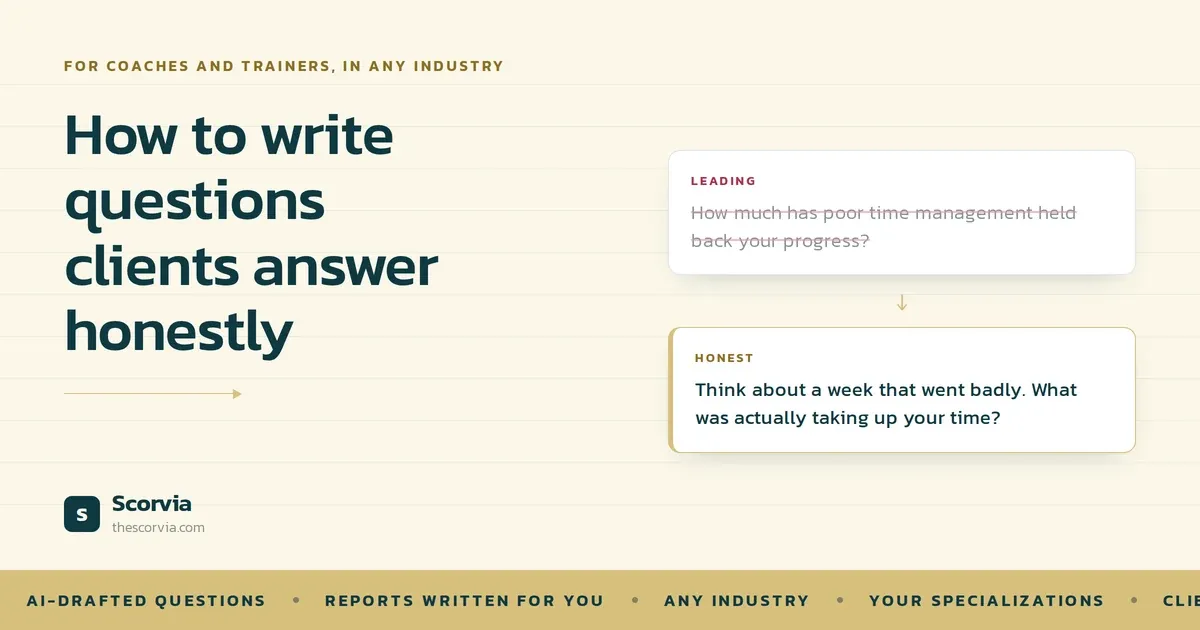
❌ How much has poor time management held back your progress this year?
You have diagnosed the problem before the client has said a word. Someone who does not think time management is their issue now has to either correct you or go along with it. In an intake form, before they know you, almost everyone goes along with it.
✓ Think about a week this year that did not go the way you wanted. What was actually taking up your time?
The second version cannot be answered with the number the client thinks you are hoping for.It asks for an account of something that happened.
The tell is usually an adjective doing the judging. Scan your draft for poor, struggle, lack of, failing to, how much has. If the question contains a verdict, it is leading.
2. Two questions wearing one coat
❌ How confident are you in giving difficult feedback and handling conflict?
A manager might be genuinely good at one of those and quietly dreading the other. Whichever way they answer, the information you needed is gone — and you will not know it is gone, which is worse.
Split it. Two questions, a few seconds longer, twice the signal. This one hides behind an “and” or an “or”, so search your draft for both and check each one.
3. A scale with nothing holding it up
❌ Rate your work-life balance from 1 to 10.
One person's 6 is another person's 3. Worse, you cannot compare the same client's answer eight weeks later, because they will have recalibrated what 6 means in the meantime — usually in whichever direction makes them feel better about the effort they have put in.
Anchor the ends, and make the anchors describe behaviour rather than feeling:
On a typical weekday, how often does work take time you had set aside for something else?
1 —Almost never.
3 — Once or twice a week.
5 — Most days.
7 — Every day, weekends included.
Now the number means something specific, and it means the same thing in twelve weeks. A move from 5 to 3 is a real change you can describe in a progress report, rather than a mood you are guessing at.
4. Asking the client to be their own analyst
❌ What are your limiting beliefs about money?
Almost nobody can answer this honestly, because almost nobody experiences their beliefs as limiting. They experience them as accurate. Ask this and you get either a shrug or a phrase someone repeated to them on a course.
Ask for the behaviour instead, and do the interpreting yourself — that is the part you are being paid for.
✓ When was the last time you decided not to raise your rates? What was going through your head at the time?
You get a story. The story contains the belief, and it contains the evidence the client is using to hold it. Both are more useful than a label, and the client is far more likely to accept your reading of it later, because it came from something they told you.
If you change one thing about your questions after reading this, change this one. Move the question from the conclusion back to the observation.
5. Your vocabulary instead of theirs
Every coaching qualification issues its own vocabulary, and after a few years it becomes very hard to hear how it sounds from outside. “Where are you on your leadership journey?” is perfectly clear to you and mildly excruciating to a warehouse operations manager who has been sent on a development programme.
Write in the language the client uses at work, not the language you learned in training. If you coach in a field you did not come from, the fastest fix is to read three job adverts for their role and borrow the words.
6. Too many questions
There is a point in every assessment where a client stops thinking and starts finishing. For most people it arrives somewhere past the twentieth question, and much sooner if several of them are open text.
Everything after that point is costing you data quality — not just on those questions, but on the impression the client is forming about whether you know what you are doing.
So how many questions should you ask?
There is no universal number, but these hold up well across most coaching contexts:
- Pre-session intake : eight to twelve. You are establishing context, not conducting research.
- Mid-programme check-in: five to eight, repeated identically eachtime so the trend is real.
- Full diagnostic you charge for: twenty to thirty is defensible, because the client has bought the depth.
- Post-session feedback: three or four. Anything longer gets skipped, and a skipped survey tells you nothing.
If you cannot say what you would do differently depending on how a client answers, the question is not earning its place. Cut it.
Mix the formats on purpose
Most coaches default to whichever format they find easiest to write. Each one is good at something different:
- Multiple choice— fast for the client, comparable across a cohort. Best for anything you want to count, and each option can carry its own mark.
- True or false— good for screening and for surfacing assumptions quickly. Weak for anything with nuance. Marked one or zero.
- Detailed, or open text— where the sentence you eventually quote in the report comes from. Expensive in client effort, so spend it carefully. Not scored, and it should not be.
Scoring is a property of the first two rather than a format in its own right, and it is those scored questions that give you a trend line — provided you never reword them between runs.
A working ratio: no more than three open-text questions in an intake, and put them at the end. By then the client is warmed up and the earlier answers have given them something to react to.
Branch instead of lengthening
The usual reason an assessment gets too long is that it is trying to cover every client at once. A question that only matters to a third of your clients is dead weight for the other two-thirds — and they are the ones who will feel the form does not understand them.
Conditional logic solves this, and in most tools it is a switch you turn on per assessment rather than something you have to design around from the start. Ask one screening question, then send people down different paths based on how they answered. A twelve-question assessment that adapts will out-perform a forty-question one that does not, on both completion rate and the quality of what comes back.
This is also the honest answer to “my clients are all so different.” They are. The form should be too.
The test to run before you send anything
Three checks. Together they take about ten minutes and catch most of what is wrong.
- Answer it yourself, as your most sceptical client. Not your ideal client — the one who thinks assessments are a bit much. Any question you find yourself answering strategically rather than truthfully needs rewriting.
- Read every question a loud.If you stumble, or hear yourself sounding like a brochure, the client will hear it too. This one test catches more bad writing than any checklist.
- For each question, ask what you would do differently depending on the answer. If you cannot say, it is a question you are asking out of habit.
Where AI helps with this, and where it does not
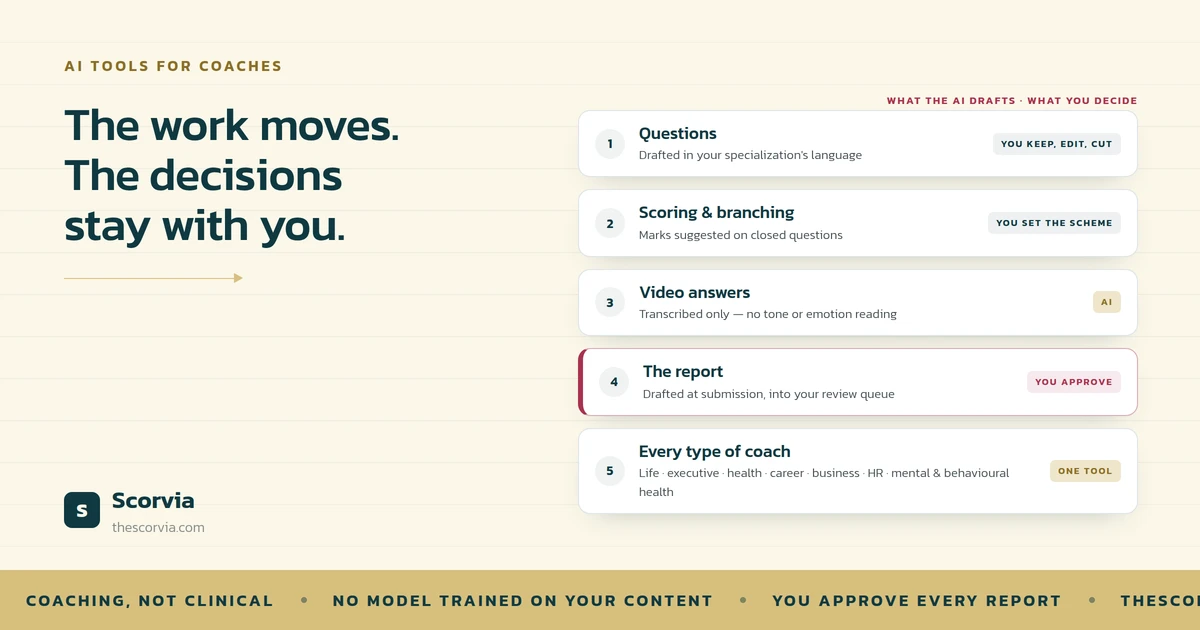
AI is genuinely good at the first draft. Give it the category you are assessing and it will produce a set of questions in the vocabulary of that field faster than you can type them — which matters most when you are working outside your original specialism and do not yet have the words.
It is also more steerable than most people expect. You pick the question type, say how many you want, and add a note if you have one — shorter, or about mornings — then keep the ones that fit and dismiss the rest.
What it will not do is know which question matters for the client sitting in front of you next Tuesday. It does not know that this person has just been passed over, or that their last coach used the same phrasing and it went badly. That judgement is the job, and it is not going anywhere.
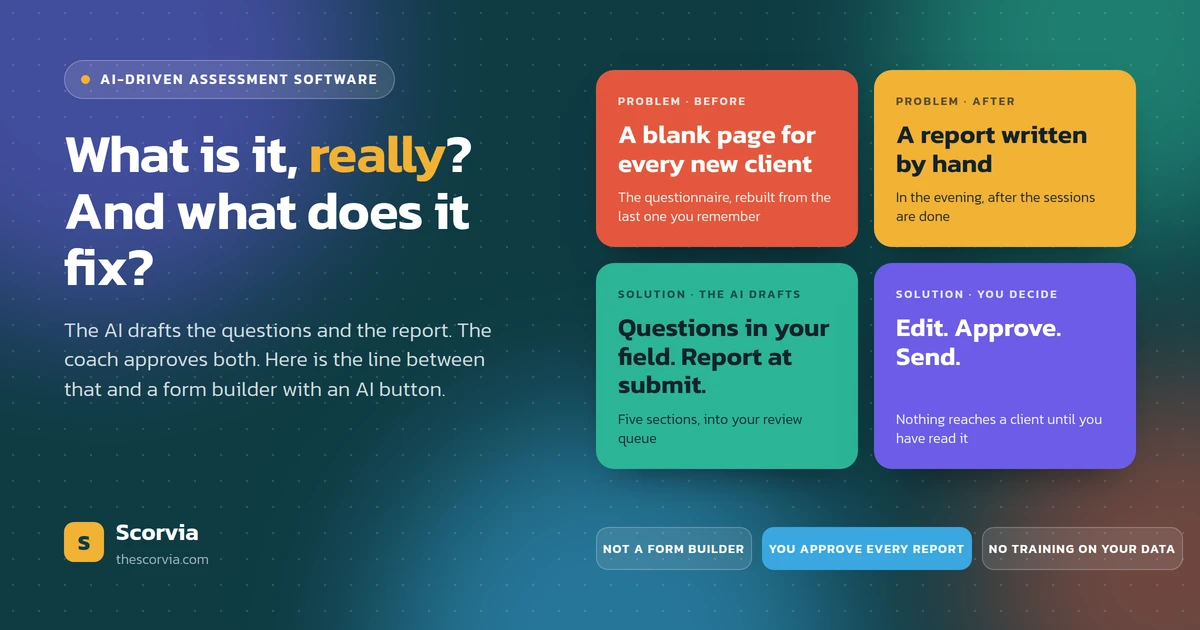
Which is the argument for tools that let you ignore the generator entirely. In Scorvia you can drag a blank multiple-choice, true/false or open-text question onto the page and write it yourself, exactly as you would have anyway. The drafting is there for the first pass, not for the decisions. The questions stay yours, and so does the judgement about which ones to ask.
The short version
- Cut the adjective that does the judging.
- One question per type.
- Anchor every scale in behaviour, then never reword it.
- Ask what happened, not what they believe.
- Use their words, not your training's.
- Branch rather than lengthen.
- Read it aloud before you send it.
None of this is complicated. It is just easy to skip when you are writing the form ten minutes before a client needs it — which is exactly when most assessments get written, and exactly why most of them come back with polite, useless answers.