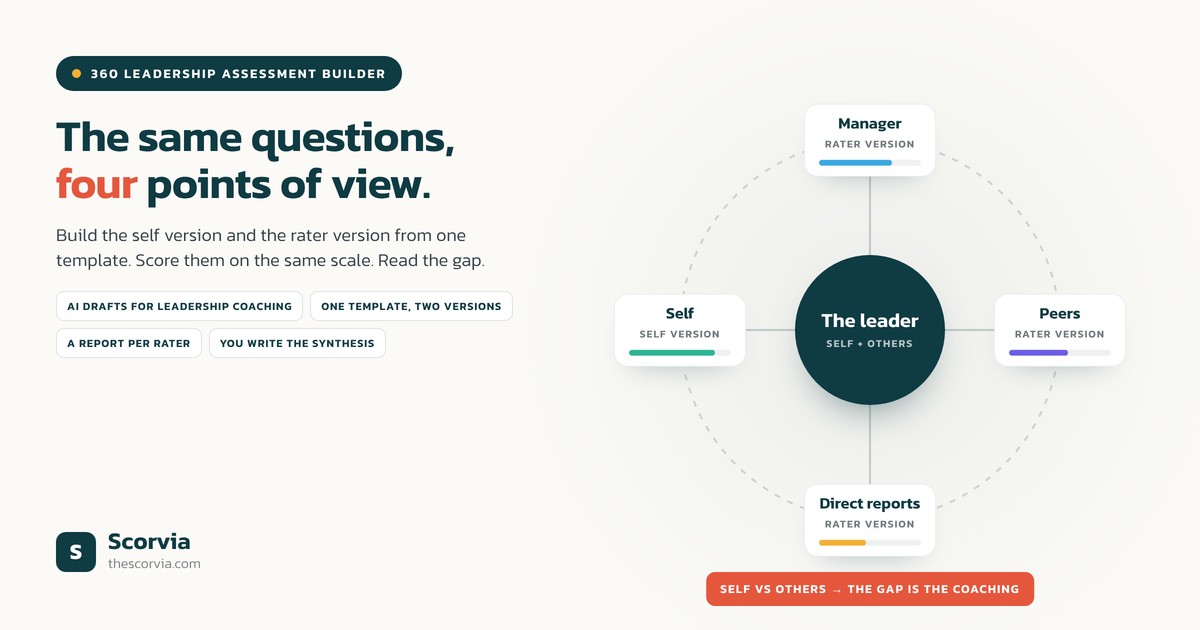
A 360 leadership assessment builder tool lets a leadership coach create their own multi-rater assessment: the same questions answered by the leader, their manager, their peers and their direct reports, so the gap between self-view and how others experience the leader is visible. In Scorvia, you set the specialization to leadership coaching, the AI drafts the question set in the leader's language, you edit, score and branch it, save it as a template, and send the self and rater versions. Each submission is drafted into a report for you to read; you write the synthesis.
What a 360 leadership assessment is
A 360 leadership assessment asks the same questions of the leader and of the people around them: their manager, a few peers and a few direct reports.
The point is not the score. It is the distance between the leader's score and everyone else's, theme by theme.
That distance is the material of leadership coaching. How to read it is its own subject, covered in five kinds of self-awareness gap; this post is about building the instrument that shows it.
Why a leadership coach builds their own
A coach builds their own 360 when the engagement needs the coach's model, the client's language, and the themes that matter to this leader, rather than a fixed instrument.
A licensed 360 comes with validated norms and a question set that cannot change. That is the right choice when a client needs a benchmark against a population.
A coach-built 360 is the right choice when the coach already knows what they are looking for. It asks about the behaviours the engagement is about, in words the leader's team actually uses, and it can be sent again at the end of the plan to show what moved.
Scorvia is a builder for the second kind. It carries no validated norms and is not a substitute for a licensed instrument.
What to include in a 360 leadership assessment
Include the behaviours other people can actually observe, because raters can only rate what they have seen.
Delegation: what the leader hands over, what they hold, and what comes back. Decisions: how they are made and how they are explained. Feedback: what the leader gives, what they receive, and what they do with it.
Communication under pressure, because that is where the self-view and the team's view separate fastest. And one open question for every rater: what should this leader keep doing, and what should they stop.
Leave out anything a rater would have to guess at. A direct report cannot rate how the leader negotiates with the board.
How to build a 360 leadership assessment in Scorvia
Seven steps, in the order they happen in the assessment builder.
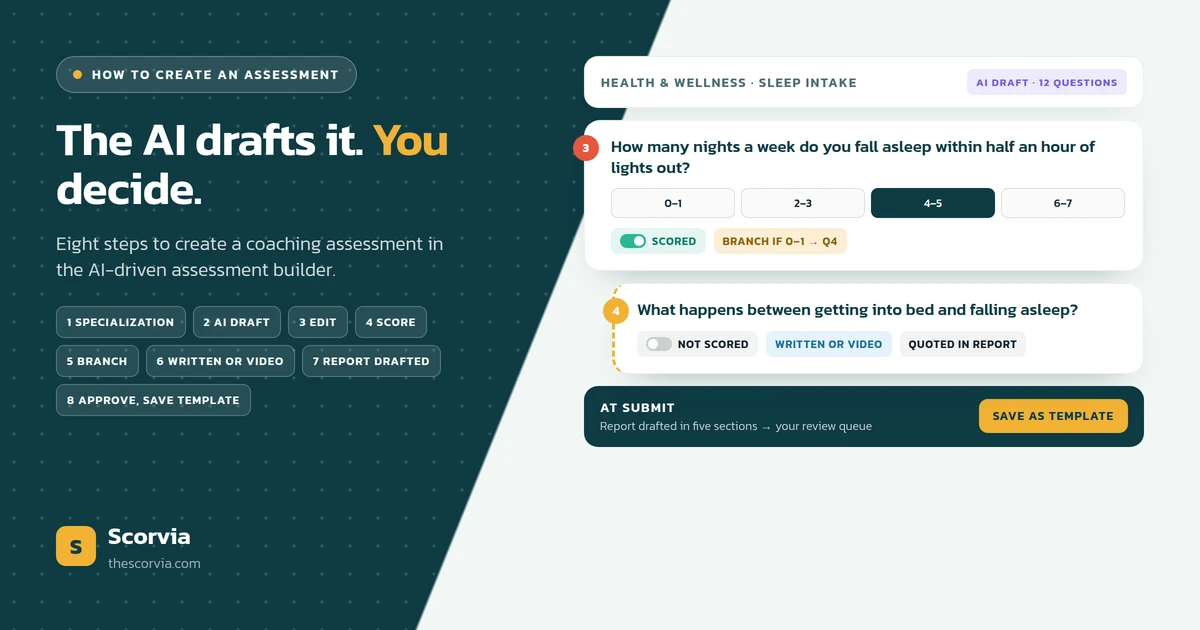
1. Set the specialization to leadership coaching
Everything the AI drafts is written for the field you name, so name it first. The draft that follows uses the words leaders and their teams use, not assessment jargon.
2. Draft the self-assessment and edit it hard
Ask for a question set on the themes a 360 needs: delegation, decisions, feedback given and received, communication under pressure, and how the leader believes they come across. Keep the questions that will produce a usable gap, rewrite the rest.
3. Score the closed questions so raters can be compared
A 360 lives on comparison, so the closed questions carry a score: the same scale for the leader and every rater. Leave the open questions unscored; their answers are the sentences you will quote back.
4. Make the rater version from the same template
Save the self-assessment as a template, copy it, and rewrite each question from the rater's side: 'this leader' where the self version says 'I'. Add a branch so a rater who has not seen a behaviour is not asked to rate it.
5. Send the right version to each person
The leader gets the self version. The manager, a few peers and a few direct reports each get the rater version. Everyone answers online, one question at a time, in writing or on video, and can save and finish later.
6. Read each drafted report, then write the synthesis
Every submission is drafted into a report in your review queue the moment it arrives. Read the leader's, then the raters', and write the synthesis of the gap in your own words before the debrief. Nothing reaches the leader until you approve it.
7. Turn the gap into the plan
The debrief ends with the leader's plan for the next quarter: one goal per gap, and the actions under each. Send the same 360 again at the end of it, and the two scores show what moved.
Self version and rater version, side by side
Both come from one template. The table shows what changes and what must not.
| Self version (the leader) | Rater version (manager, peers, direct reports) | |
|---|---|---|
| Who answers | The leader | Each rater, separately |
| Question wording | 'I explain the reasons behind my decisions.' | 'This leader explains the reasons behind their decisions.' |
| Scored questions | Same scale | Same scale, so the gap is a number |
| Branching | None needed | 'Have you seen this leader do this?' If not, the rating is skipped |
| Open questions | 'What do I find hardest to delegate?' | 'What should this leader keep doing? What should they stop?' |
| How they answer | Online, in writing or on video | Online, in writing or on video |
| What the coach receives | A drafted report in the review queue | A drafted report per rater in the review queue |
| What the leader receives | Nothing until the coach approves the synthesis | Nothing; raters' reports go to the coach |
Sending one assessment to several people and getting a report for each is the same mechanism as assessing a team; how to assess a whole team covers it for cohorts.
Reading the reports: the part that stays with the coach
Each submission is drafted into a report in your review queue the moment it arrives: summary, key findings, strengths, areas to work on, recommendations, and on scored assessments an overall score and chart.
Scorvia does not merge the raters' reports into one. You read the leader's report and the raters' reports side by side and write the synthesis of the gap in your own words.
That is deliberate. The reading of a 360 is the coaching, and nothing reaches the leader under your name until you have approved it.
From the debrief to the plan
The debrief ends with a plan: one goal per gap, and the actions under each, built in the plan builder and followed by the leader in their own calendar.
At the end of the plan, send the same 360 again. The second set of scores against the first is the evidence of what changed, and it is in the same client record as everything else.
Three things to get right with raters
Tell every rater before they start how their answers will be used and who will read them. A rater who is unsure says less.
Choose raters who have seen the leader's work first-hand and recently. A peer from another floor is a guess, not a rating.
Keep the rater version short. Raters are doing a favour; a 360 that takes an evening gets answered on the last day, badly.
Common questions
What is a 360 leadership assessment builder tool?
A 360 leadership assessment builder tool lets a leadership coach create their own multi-rater assessment: the same questions answered by the leader, their manager, their peers and their direct reports, so the coach can see where the leader's view of themselves differs from how others experience them. In Scorvia, the coach sets the specialization to leadership coaching, the AI drafts the question set, and the coach edits, scores and branches it, saves it as a template, and sends the self and rater versions to each person.
How is a 360 assessment different from a leadership self-assessment?
A self-assessment has one rater: the leader. A 360 adds the people around them, usually the manager, two or three peers and two or three direct reports, answering the same questions from their side. The value is in the gap between the two, which is why the closed questions carry the same score for every rater.
Should a leadership coach build a 360 or use a licensed instrument?
Both have a place. A licensed instrument comes with validated norms and a fixed question set, and is the right choice when a client needs a benchmark against a population. A coach-built 360 fits the engagement: the coach's own model, the client's language, the themes that matter to this leader. Scorvia is for the second kind; it does not carry validated norms and is not a substitute for a licensed instrument.
How many raters does a 360 leadership assessment need?
Enough that no one rater can be identified from the answers, and few enough that every rater knows the leader's work first-hand. A manager, a small group of peers and a small group of direct reports is the usual shape. Tell every rater before they start how their answers will be used and who will read them.
Does the AI combine all the raters' answers into one 360 report?
No. In Scorvia each submission, the leader's and each rater's, is drafted into its own report in the coach's review queue. The coach reads them side by side and writes the synthesis of the gap for the leader. That is deliberate: the reading of a 360 is the coaching, and it is not delegated to the AI.
What happens to the 360 after the debrief?
It becomes the plan and the baseline. The debrief ends with one goal per gap and the actions under each, built in the plan builder and followed in the leader's calendar. The same 360 sent again at the end of the plan gives a second set of scores, and the difference between the two is the evidence of what changed.
The builder, templates, reports and plan builder above are described on the AI-driven assessments for leadership coaches page.
Set the specialization to leadership coaching, draft the self version, and count the questions you would keep. 14-day free trial, no card see assessments for leadership coaches, or pricing.