AI-driven assessment software is software that drafts a coaching assessment and its client report, instead of only hosting a form. You name your specialization, the AI writes the questions in that field's language, the client answers online or on video, and a report is drafted from their answers the moment they submit. You edit and approve every draft before the client sees anything.
The question coaches are asking
The question is usually some version of this: is AI-driven assessment software a real category, or a form builder with a new label?
It is a fair question. Most tools that use the phrase added an AI button to a questionnaire product and changed the headline.
The answer depends on one thing: what the software does after the client clicks submit. This post is about that difference.
The problem: two blank pages for every client
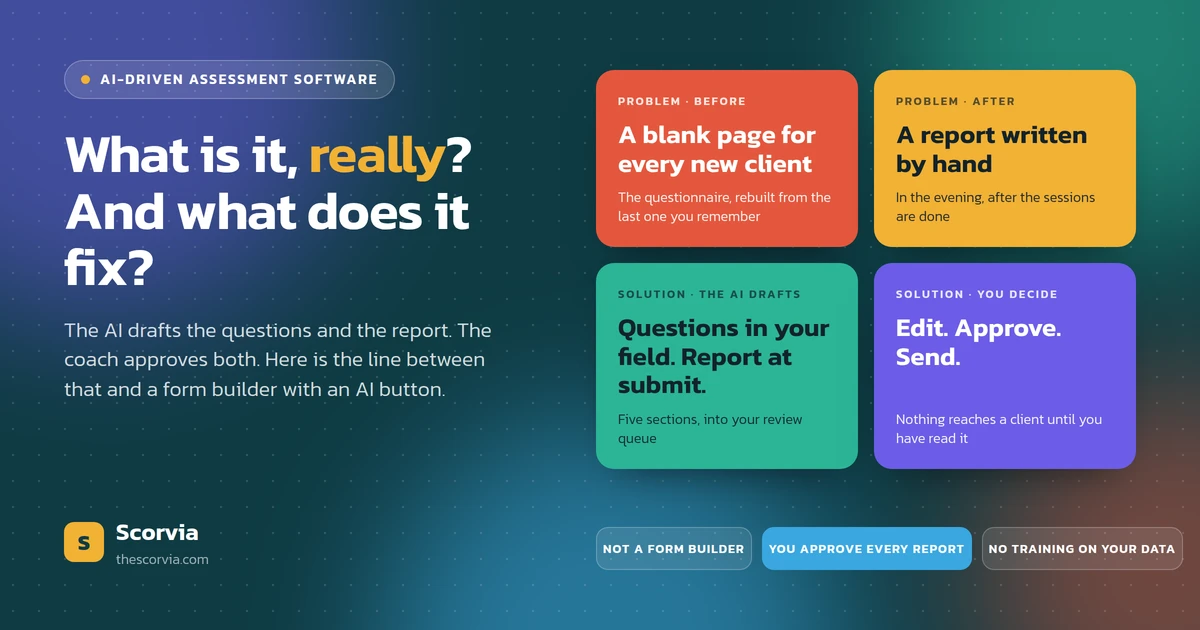
The problem is that a coaching assessment costs you a blank page twice. Once before the client answers, and once after.
Before, you write the questions. A new client type means a new questionnaire, built in a form tool from the last one you remember, and the good questions from six months ago are in a document somewhere.
After, you write the report. The answers come back as a spreadsheet row or a PDF, and turning them into something a client can act on happens in the evening, after the sessions are done.
Around both sits a third problem: the assessment is in one tool, the answers in another, the report in a document, and the client's record in a fourth. Nothing connects them, so every step is a hand-off.
Form builders solve the middle of this, collecting answers. They leave both blank pages exactly where they were.
The solution: software that drafts both ends
The solution is software that drafts the assessment and drafts the report, and routes both through you. That is what AI-driven assessment software means when the phrase is used properly.
It starts from your field, not from a blank form. You name your industry and specialization, and the questions are drafted in the language those clients use.
It ends with a drafted report, not an export. The moment a client submits, a report is written from their answers and placed in your review queue.
And it keeps the record together. The assessment, the answers, the report and the client sit in one place, so there is nothing to copy across.
How AI-driven assessment software works
It works in five steps, in the order a client experiences them.
1. You name the field, and the AI drafts the questions
You set your industry and specialization, and the software drafts a question set in the language those clients use. You keep, rewrite or delete every question, add scores to the closed ones, and add a branch where one answer should change the next.
2. You save it as a template
The finished assessment is kept as a template for that client type. The next client gets the template, not a rebuild.
3. The client answers online, in writing or on video
The client works through the questions one at a time, with nothing to install, and can save and finish later. Video answers are transcribed and the transcript becomes the answer.
4. The report is drafted the moment they submit
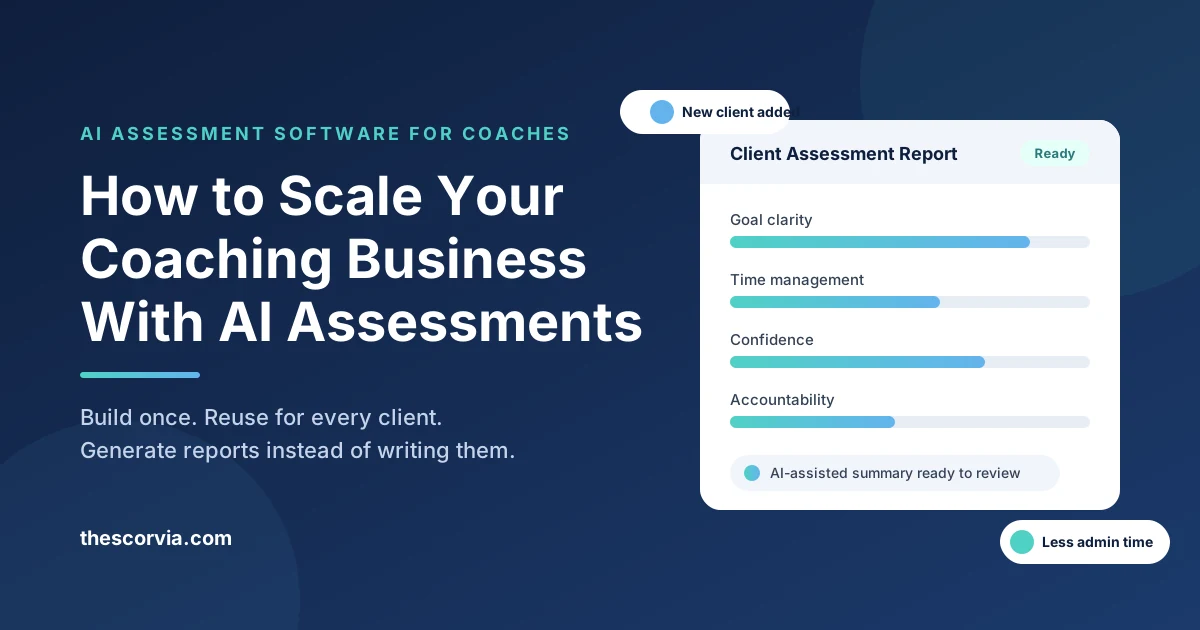
A report is written from the client's answers as soon as they finish: summary, key findings, strengths, areas to work on and recommendations. It goes to your review queue, not the client.
5. You edit, approve and send
You change any section by hand or ask the AI to redraft one section, add a note in your own words, and approve. The approved report carries your logo and can be downloaded as a PDF.
What makes it 'AI-driven' rather than 'AI-added'
The difference is whether the AI is in the workflow or beside it. A table makes the line clear.
| Question | Form builder with an AI feature | AI-driven assessment software |
|---|---|---|
| Where does an assessment start? | A blank form, with AI help writing fields | Your specialization: a drafted question set in that field's language |
| Can questions be scored and branched? | Sometimes, by hand | Scores suggested on closed questions; branches added where an answer should change the next question |
| How does the client answer? | A web form | Online, one question at a time, in writing or on video; save and finish later |
| What happens at submit? | An export, a notification, or a results page | A report is drafted in five sections and placed in your review queue |
| Who sends the report? | You, after writing it | You, after editing and approving the draft; the client sees Under Review until then |
| Where does the record live? | In the form tool, until you move it | With the client: assessment, answers, report and sessions together |
Read the last two rows twice. Approval and a single record are the two things a form builder cannot add with a feature, because they are not features. They are the shape of the product.
What it should never do
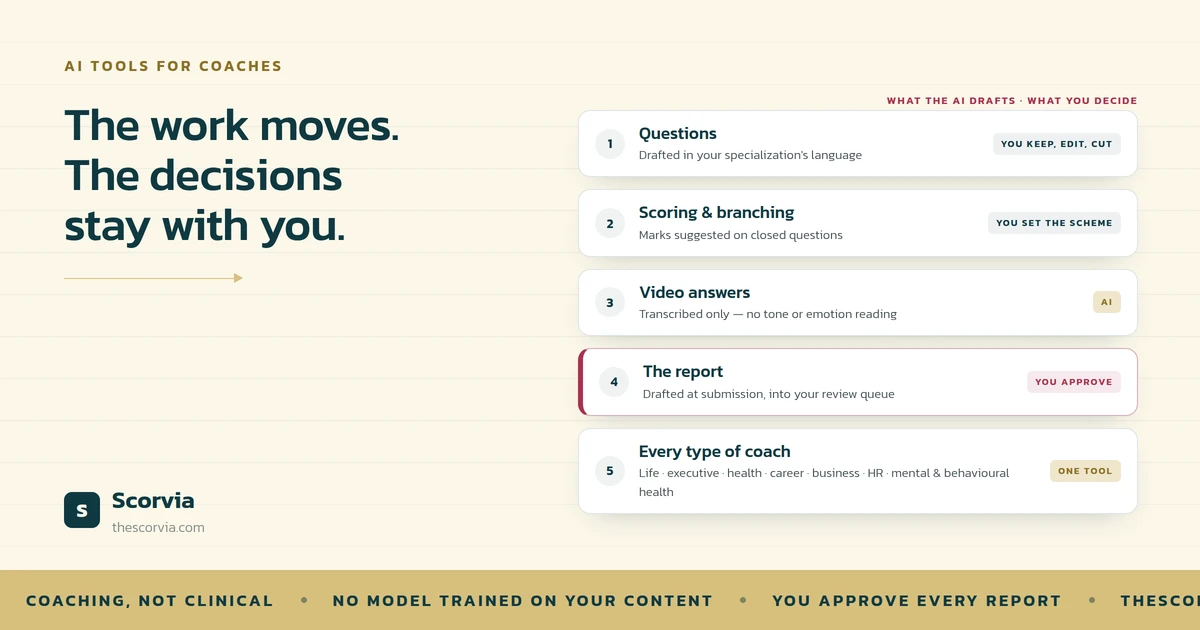
It should never send a report the coach has not read. A draft is a draft until a person approves it.
It should never learn from your clients. No model should be trained on your questions, your assessments or their answers. Noticing which suggestions you keep is a preference, not training.
It should never pretend to be clinical. For mental health and behavioural health coaches, an AI-driven assessment is a coaching assessment: it reflects what the client said, does not diagnose, screen or assess risk, and is not a substitute for a licensed instrument.
The AI drafts. The coach decides. If a tool blurs that line, it is not the category this post describes.
Who it is for
It is for any coach or trainer whose work starts with questions and ends with a written report.
That covers life, executive and leadership, health and wellness, career, business, HR and behavioural health coaches, and financial advisors running client discovery. The mechanism is the same for all of them; the question set is not.
If you already use a builder and want to know what the steps after the form look like, why coaches need more than an assessment builder walks through them.
Common questions
What is AI-driven assessment software?
AI-driven assessment software is software that drafts an assessment and its report, rather than only hosting a form. The coach names a specialization, the AI writes a draft question set in that field's language, the client answers online, and a report is drafted from the answers the moment they submit. The coach edits and approves every draft before anything reaches the client.
What problem does AI-driven assessment software solve?
Two kinds of repeated work: writing the same assessment again for every new client, and writing the client report by hand after every submission. It replaces the blank page at both ends with a draft the coach edits, and keeps the assessment, the answers and the report in one place instead of across a form tool, a spreadsheet and a document.
How is it different from a form builder with an AI feature?
A form builder with an AI feature helps you write a form. AI-driven assessment software starts from your specialization, drafts the questions and the report, routes the report through your approval, and keeps the whole record with the client. The test is simple: ask what happens after the client clicks submit. If the answer is an export, it is a form builder.
Does the AI send reports to clients?
No. In Scorvia the drafted report lands in the coach's review queue, and the client sees an Under Review badge until the coach has read, edited and approved it. Nothing reaches a client under the coach's name without the coach's approval.
Is client data used to train the AI?
No. No model is trained on a coach's questions, assessments, client answers or approved reports. The only adaptation is a preference signal: which suggested questions a coach keeps and which they dismiss shapes the next draft.
Who uses AI-driven assessment software?
Coaches and trainers whose work starts with questions and ends with a written report: life, executive and leadership, health and wellness, career, business, HR and behavioural health coaches, and financial advisors running client discovery. For mental health and behavioural health coaches it produces coaching assessments only: no diagnosis, no screening, no risk assessment, and no substitute for a licensed instrument.